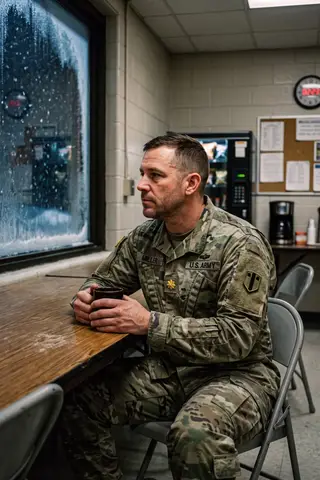
 He Told His Army Major Son Not to Come Home for Christmas Because It Would 'Overshadow' His Stepbrother
Chapter 1
The Exclusion
The snow was already beginning to drift across the motor pool by the time my phone buzzed against the heavy wool of my uniform trousers. I stood in the corridor of the command building, the dull hum of the base generator vibrating through the concrete floor. Outside, the Colorado sky hung heavy and slate-gray, threatening the kind of winter storm that cleared highways and trapped families indoors before they even had a chance to carve the roast.
I pulled the phone from my pocket. The caller ID displayed a single, heavy word: Dad.
"Major Cole speaking," I answered, keeping my voice clipped and professional, the tone I used when managing supply chains or coordinating troop movements. It was a habit I could never quite shake, even when off duty.
"Don't come this year."
The words weren't a greeting. They weren't even a question. They dropped into the line like stones down a dry well.
I paused, my hand resting on the brass handle of my office door. "Excuse me?"
"You heard me, Cole," my father’s voice came back, tight and hurried, as if he were speaking from a crowded room where he didn't want to be overheard. "Jason’s going to be here. People from his firm, some local dignitaries, neighbors. They’re going to be asking about careers, promotions, all of that. Jason just got made vice president. This is his night."
"Jason is your stepson, Dad. And I’m your son," I said, a familiar, cold ache settling behind my ribs. "Though sometimes it’s hard to tell which order you prefer."
"Don't start with that martyr routine," my father snapped, his voice rising just enough to reveal the panic underneath. "You know how things are. People see an Army major in dress uniform with deployment ribbons, and all the oxygen leaves the room. Jason’s promotion is delicate. It’s corporate. He’s worked hard for this stepping stone, and I don't need your war stories overshadowing what he’s accomplished."
For eighteen years, I had worn the uniform through dust storms in the Middle East, freezing field exercises in the Rockies, and endless nights staring at operational maps while my peers built civilian lives. I had missed Thanksgivings, funerals, and birthdays because the mission came first. I had accepted that sacrifice as the cost of service.
What I had never accepted—and what still managed to burn—was that my own father viewed my service not as a duty fulfilled, but as a social inconvenience.
"You think me sitting at your dinner table will embarrass him?" I asked, my grip tightening on the phone until my knuckles turned white.
"I think you’ll take attention away from him, and I won't have it," my father said flatly. "Stay in Colorado. Catch up on your paperwork. We’ll FaceTime you when we open the champagne. Have a good Christmas, Cole."
The line clicked dead. A dial tone hummed in my ear, steady and mechanical, matching the coldness in the hallway.
I didn't yell. I didn't slam my phone against the wall. Instead, I slowly lowered my hand, slipped the device back into my pocket, and pushed open my office door. On my desk sat the airline ticket I had purchased two months prior—a non-refundable seat on a morning flight out of Denver, bound for a home that had never truly felt like mine since my mother passed away.
Beside the ticket lay a stack of duty rosters. Half the unit was scheduled for holiday leave, leaving a skeleton crew to manage base security and emergency response readiness through the blizzard warning.
I picked up the ticket, folded it neatly twice, and dropped it into the metal wastebasket beside my desk.
"Cancel the flight," I whispered to the empty room. "Mission accepted."
The End









