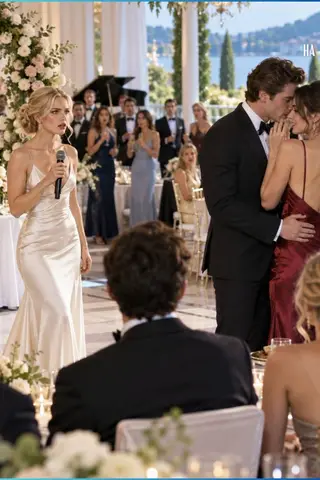
 He Thought She Only Knew Basic French
Chapter 2
The Roots of the Deception
Long before the glittering chandeliers of the Hawthorne Grand, long before the ivory napkins and the string quartet, Nora had learned a fundamental truth about men like Graham Whitmore: they mistook quiet observation for ignorance. Growing up the daughter of an Army nurse and a high school French teacher, Nora’s world was built on discipline, situational awareness, and the gritty reality of international logistics. While Graham spent his childhood summers sailing off Martha’s Vineyard and learning how to sign checks he didn’t earn, Nora spent her teenage years helping her mother grade papers, listening to harrowing stories of field hospitals in Belgium, and absorbing a second language the way others absorb pop music.
When she attended Georgetown University, she didn't major in French literature to look cultured at dinner parties; she paired it with international supply-chain management because she wanted a career where language was a weapon of commerce. By twenty-eight, she was negotiating multi-million-dollar manufacturing contracts across Europe and North Africa. She knew how factories operated, how raw materials moved, and how people lied when millions of dollars were on the line.
Graham, on the other hand, had spent a single year in Paris living in a cushioned expatriate bubble where his parents paid his rent, and he treated the language like an exclusive country club membership card. To Graham, French was not a tool for communication; it was an aesthetic. It was something you used to order wine, look sophisticated, or whisper secrets right in front of people you assumed were too provincial to understand.
When they met at a charity gala in Back Bay two years prior, Graham had approached her with the practiced grace of a man accustomed to easy conquests. He liked her posture, her calm demeanor, and the way she listened without interrupting. He had labeled her "stable." In Graham’s vocabulary, "stable" was a polite euphemism for predictable, unthreatening, and ultimately forgettable once the excitement of youth wore off.
On their second date, when he asked if she spoke French and she replied with a modest "A little," she had watched the flicker of mild disappointment in his eyes. He didn't want a partner who could challenge him intellectually; he wanted an audience. So she let him play the mentor. She smiled politely when he corrected her pronunciation of croissant—even though she had eaten fresh pastries in Lyon bakeries he couldn't even map on a napkin. She let him feel like the smartest man in the room because, at the time, she was building a life, not keeping score.
It was only during the past six months, as the wedding preparations accelerated under Evelyn’s tyrannical eye, that the cracks began to show. Graham started taking late-night calls in his study, closing doors softly, and vanishing for weekend business trips to New York that suspiciously lined up with Claire Beaumont’s art gallery openings. Nora hadn't needed to hack his phone or rifle through his desk. She had simply listened to the cadence of his voice through the half-open door of his office, heard the familiar cadence of fluent, relaxed French—a fluency he never used with her—and connected the dots. She didn't throw a plate. She didn't cry. She simply waited for the exact right moment to verify her hypothesis on a grander stage.
The End









