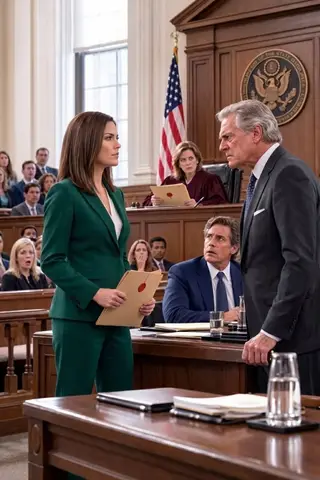
 He Sued His Own Military Daughter for Her Inheritance
Chapter 1
The Trap at the Defense Table
The air inside the federal courtroom tasted of dry paper, floor wax, and the distinct metallic tang of impending humiliation. At the plaintiff’s table sat Arthur White, wrapped in an immaculate bespoke charcoal suit that cost more than my first used sedan. Beside him, his high-paid attorney, Gerald Foss, flipped through a thick leather-bound binder with the smug, unhurried ease of a man who believed the game was already won.
Across the aisle, I sat alone at the defense table. My uniform was back at the base, but the discipline remained. I wore a simple charcoal suit of my own—clean, pressed, and entirely devoid of ostentation. To anyone observing from the wooden benches of the gallery, the visual disparity was stark. Arthur had money, social standing, medical affidavits, a cooperative older daughter, and a legal team that treated the courtroom like a private playground.
He leaned across the aisle, his voice a low, gravelly sneer designed exclusively for my ears. "You'll never be my pride," he murmured, his eyes cold as winter stone. "Sign the house back over before I crush whatever dignity you have left."
I didn’t blink. I didn’t shift in my seat.
"Look at you," he continued, emboldened by my silence. "A lowly grunt thinking she can stand against me. You survived the sandbox, but you won't survive this."
What Arthur mistook for helplessness was military-grade discipline. He had spent my entire life underestimating what quiet observation could achieve. Ever since my mother passed away when I was nine years old, Arthur had played the role of the grieving, noble widower to the outside world, while running our home like a strict military prison camp where he was the sole general. My older sister, Lauren, had figured out the rules early on: submission brought luxury. She got the designer clothes, the sports cars, the lavish praise at country club dinners, and a guaranteed place of honor at his right hand.
I chose a different path. I chose resistance, and resistance always came with an itemized invoice.
I remembered the night I turned sixteen, sitting at the kitchen table while my father slid a printed invoice across the polished oak. It was itemized on company letterhead: Bedroom occupancy: $450/month. Utilities share: $120. Grocery allocation: $85. I had been working evening shifts at a local diner just to pay for my own school supplies, yet somehow I owed back-rent to the man who had sired me. On Christmases when Lauren unwrapped diamond earrings, I received a sealed envelope containing a ledger of my debts.
Years later, when I earned my commission at Fort Benning, standing proudly in my dress uniform with dust still clinging to my boots from field training, Arthur walked right past the senior officers, looked down at my footwear, and told the battalion commander that I had joined the military simply because I was too weak to survive in the real corporate world.
The only anchor I had through those grueling years was my grandmother. Gran never bought into Arthur’s narrative. She drove hundreds of miles to attend the ceremonies he sneered at. She sent handwritten letters filled with fierce love and pride while I was deployed overseas. When Gran looked at me, I never felt like the family disappointment Arthur constantly preached about.
Then, fourteen months after my commissioning, Gran passed away.
The reading of her will in Winston-Salem should have been a sacred family moment, but Arthur treated it like a hostile corporate takeover. He sat at the mahogany table, checking his Rolex every thirty seconds, fully expecting Gran’s sprawling historic estate, the surrounding land, and every cent of her estate to roll seamlessly into his portfolio.
Instead, the attorney read the final clause: To my granddaughter, Captain Maya White, I leave my entire estate, lock, stock, and barrel.
Arthur didn’t yell. He simply lifted his cup of Earl Grey tea, took one slow, deliberate sip, and smiled a smile that chilled the room. "You think you can keep it, little soldier?" he asked softly.
That smile birthed the lawsuit we were fighting today. He claimed undue influence, alleging that I had manipulated an elderly woman on her deathbed. He recruited Lauren to sign a perjured affidavit. He leaked anonymous complaints to my military command, freezing my security clearance and turning my workplace into a minefield of sideways glances and silent treatment.
Three months prior to this trial, at my niece’s birthday party, Arthur had cornered me near the pantry while guests laughed under the patio string lights. He had smiled that same predatory grin, asking if my commanding officer had received the disciplinary letters yet. Then he whispered, "Where is a grunt like you going to get the fifty thousand dollars required just to retain counsel against me?"
That was when I noticed the unnatural, rigid square bulging beneath his suit jacket. A hidden recording device. He wanted me to snap. He wanted one unhinged, emotional outburst he could play for the judge to prove my instability.
Instead, I looked straight into his eyes and gave him the exact ammunition he didn't know how to use: "Thank you for the advice, Mr. White."
For a split second, his absolute composure cracked. It was the only victory I needed before stepping foot inside a federal courtroom.
Now, trial day had arrived. Judge Patricia Okafor sat at the bench, her expression stern and immovable. Gerald Foss presented his opening statements with theatrical flair, parading medical opinions and putting a weeping, trembling Lauren on the witness stand to testify about Gran's supposed mental decline. Arthur watched me from across the aisle, his chin tilted up, bathing in the pre-emptive glory of his triumph.
They thought every single piece of their carefully orchestrated puzzle had landed precisely where it needed to be.
They waited for me to crumble under cross-examination. They waited for me to panic. Instead, I waited patiently through two hours of their theatrics until Foss finally rested his case, looking directly at the judge and stating, "Your Honor, the plaintiff has proven beyond a shadow of a doubt that the defendant manipulated a vulnerable senior citizen through fraud and coercion, going so far as to forge official documents to secure her ends."
The courtroom held its breath.
I stood up slowly from the defense table. My hand reached out and rested on the brass latch of my closed leather briefcase.
The click of the latch opening sounded startlingly loud in the dead silence of the federal room. Inside lay a single, thick, red-sealed manila folder—a file I had guarded with my life, untouched by any civilian lawyer, hidden safely within secure military channels until this exact second.
I picked up the folder, walked with measured, military precision to the court clerk, and placed it gently on the counter. I looked up at the bench and spoke my first words of the entire trial.
"Your Honor," I said, my voice steady, clear, and carrying an absolute lack of fear. "Before the defense presents its testimony, I request that the court verify the encrypted identification code located on page two of that file."
Arthur let out a low, confident huff of laughter from the plaintiff's table. Foss smirked, leaning back in his leather chair.
Judge Patricia Okafor frowned slightly at the confidence in my tone. She reached out, picked up her pen, and pulled the red-sealed folder toward her. With gloved precision, she broke the heavy wax seal, opened the cover, and began to read the first page.
Her eyes moved once across the text. Then, they snapped back to the top and read it a second time, much slower.
The smirk instantly vanished from Arthur’s face. He shifted uncomfortably in his seat.
Judge Okafor stopped turning the pages altogether. Her knuckles turned stark white as her fingers tightened around the heavy cardstock. The expensive fountain pen in her other hand slipped from her grasp, hitting the polished wooden bench with a sharp, echoing click that made the court reporter jump.
The entire courtroom froze. Absolute, suffocating silence descended upon the gallery.
Gerald Foss leaned aggressively toward Arthur, whispering something frantic and urgent into his ear. Arthur didn't answer; his eyes were glued entirely to the bench.
Judge Okafor finally lifted her gaze. She didn't look at me.
She looked directly at my father.
Her expression had hardened from judicial neutrality into a mask of pure, unadulterated shock and cold fury. When she finally spoke, her voice was so unnaturally controlled, so hushed and glacial, that even the stenographer stopped typing.
"Sir… do you know what your daughter is?"
The End









