 He Slept with Her Best Friend, Not Knowing His Wife Had Already Sold His Soul
Chapter 9
The Anatomy of a New Man
Two years passed in the valley.
The seasons in the Blue Ridge Mountains turned with a majestic, unhurried rhythm that seeped into my bones. Spring brought a riot of wildflowers across the hillsides; summer blanketed the forests in deep, emerald green; autumn set the canopy ablaze with amber and crimson; and winter wrapped the world in a blanket of absolute, meditative white.
I had stopped running from my past. I no longer woke up in a cold sweat dreaming of the federal holding facility or the cold glass of the Chicago penthouse.
The hardware store had become my entire world. Arthur, the eighty-two-year-old owner, had suffered a mild stroke late last winter, and instead of selling the business, he had quietly signed over fifty percent partnership to me, trusting me to keep the doors open and the shelves stocked.
I spent my evenings sitting on the sagging front porch of my cabin, sipping black coffee from a chipped ceramic mug, watching the sun sink behind the jagged peaks of the mountains.
My hands were permanently calloused, my back muscles corded with lean strength from hauling lumber and stacking firewood, and my reflection in the bathroom mirror showed a man I barely recognized—eyes clear, skin weathered by the mountain sun, lines of genuine humility etched around the corners of my mouth.
One evening in late October, as the first frost began to frost the edges of the creek, a sleek black sedan pulled off the gravel road and parked near the base of my cabin steps.
My heart skipped a beat.
For a second, old instincts flared—the sudden panic of a hunted animal, the fear that the past had finally caught up to drag me back into the machine.
The passenger door opened.
It wasn't Patricia Holloway. And it wasn't Claire.
Stepping out onto the gravel, dressed in a sensible wool jacket and hiking boots, was Marcus Vance.
He stood by the car for a moment, looking up at the sagging porch, taking in the woodpile stacked neatly against the side of the cabin and the wreath of dried pinecones hanging on the front door.
I stood up slowly from my rocking chair, setting my coffee mug down on the wooden railing.
“Marcus,” I called out, my voice steady. “What are you doing here?”
Marcus walked slowly up the wooden steps, his hands tucked into his pockets. He looked older than he had in the prison visitation booth two years ago, but his eyes carried a quiet, settled peace.
“I was passing through the region on business,” Marcus said, stopping at the edge of the porch. “Thought I’d see how the hardware business was treating you.”
“It’s honest work,” I replied simply. “Step up. It’s cold out here.”
Marcus climbed the remaining steps and leaned against the railing beside me, looking out over the rushing creek as the twilight painted the sky in shades of bruised purple and gold.
“You look different, Daniel,” Marcus observed quietly.
“I am different,” I answered without hesitation. “Or rather... the person you and Claire knew doesn't exist anymore. He died in that penthouse in Chicago.”
Marcus nodded slowly, acknowledging the truth in my words.
“Claire is doing well,” he said after a long silence.
I felt a slight, involuntary tightening in my chest, but the sharp pain of old betrayal was gone—replaced by a dull, respectful ache.
“I’m glad to hear that,” I said honestly. “She deserved a life built on something real. Not on the lies I was selling.”
“She runs the Vance Foundation out of Geneva and Boston now,” Marcus continued, turning to look at me. “She’s funded over two hundred sustainable community projects across developing regions. She never remarried. She says she’s finally found peace.”
“Good,” I whispered, staring out at the darkening tree line. “She earned it.”
Marcus reached into his coat pocket and pulled out a small, plain white envelope, holding it out toward me.
“She didn't send this,” Marcus clarified immediately, seeing the wary look in my eye. “I did. But I think you should read it.”
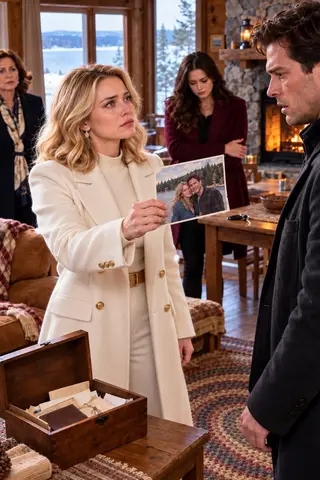
I took the envelope from his hand. I slid my thumb under the paper flap and pulled out a single photograph.
It was a picture of the Maine cabin—the same cabin where my entire world had collapsed five years ago. But the snow was gone, replaced by a lush, vibrant green meadow filled with wild ferns and blooming mountain laurel. The timber porch had been freshly stained, and a pair of rocking chairs sat side by side looking out over the lake.
On the back of the photograph, written in Marcus’s neat, block handwriting, was an address and a brief note:
The cabin was never sold, Daniel. It was placed in an independent trust—one that was never touched by the federal forfeiture. It sits empty. Waiting for someone who finally knows how to build a fire.
I stared at the photograph for a long, silent moment. The wind rustled through the pines around my mountain cabin, carrying the crisp, clean scent of approaching winter.
I looked up at Marcus.
“Why are you giving me this?” I asked softly.
Marcus smiled—a warm, familial smile I hadn't seen in over a decade.
“Because grace isn't something you inherit, Daniel,” Marcus said quietly, clapping a hand gently on my shoulder. “It’s something you build, one log at a time.”
He turned, walked back down the wooden steps, got into his sedan, and drove away into the gathering dusk, leaving me standing alone on the porch with the photograph in my hand.
I looked down at the image of the cabin in Maine, then out across the rolling hills of the Blue Ridge Mountains where my new life had finally taken root.
I didn't pack a bag. I didn't book a ticket north. I simply walked back inside my cabin, picked up my coffee mug, and smiled into the gathering dark.
Some fires are meant to burn out so you can finally see the stars.
The End









