 He Shoved Me For Refusing To Hand Over Our Kids' $3M Trust
Chapter 1
The Breaking Point
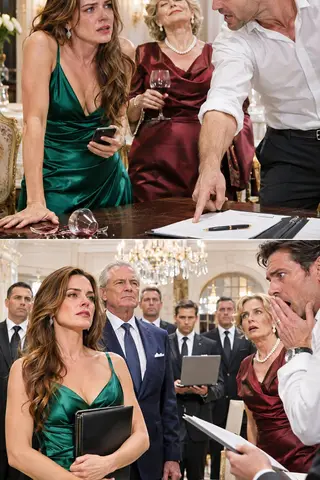
The sharp crack of the wineglass shattering against the mahogany floor sounded like a gunshot in the vaulted silence of our dining room. Shards of crystal sprayed across my bare ankles, catching the harsh glare of the modern chandelier above. The sting of the wood cutting into my lower back where Richard had shoved me was nothing compared to the cold, suffocating terror gripping my chest.
Across the room, our eight-year-old daughter, Sophie, let out a piercing shriek, burying her face into her hands as silent, trembling sobs wracked her small frame. Next to her, ten-year-old Noah stood frozen like a statue, his fists clenched so tightly his knuckles turned chalk-white. His eyes were wide, fixed on his father with a look of pure betrayal and fear that no child should ever have to direct toward the man who brought him into the world.
And then there was Victoria.
My mother-in-law didn't flinch, didn't drop her gaze, and certainly didn't show an ounce of maternal concern. She merely crossed her legs, swirling the deep crimson Merlot in her crystal goblet as if we were watching a particularly distasteful soap opera. A slow, condescending smirk curled the edges of her painted lips.
"Perhaps now she'll learn to listen to her husband," Victoria drawled, her voice dripping with calculated disdain. "Twelve years of marriage, Emily, and you still haven't learned your place. Richard is the head of this household. What he says goes."
I straightened up slowly, my breath coming in ragged gasps. The pain in my back flared, but I forced my spine to remain rigid. I refused to cower in front of them anymore. Twelve years. For twelve years, I had swallowed my pride, bitten my tongue, and tolerated the subtle jabs, the condescending remarks, and the suffocating control of the Vance family. I had played the obedient, quiet wife who stayed at home, raised our children, and kept the immaculate facade of our suburban estate shining for high-society charity galas.
They thought I was weak. They thought I was trapped.
They had no idea who my father was. Or rather, they had forgotten.
"That money belongs to our children," I said, my voice dangerously steady, cutting through the heavy tension in the room like a razor blade.
Richard Vance slammed his palm down onto the polished dining table. The legal folders containing the trust documents jumped violently from the impact. His face, usually meticulously groomed and handsome in that corporate-executive sort of way, was now twisted into an ugly, desperate snarl. Veins bulged along his temples, pulsing with a manic adrenaline.
"That money belongs to this family!" Richard bellowed, leaning over the table so far that I could smell the expensive scotch mixed with the sour stench of panic on his breath. "I'm their father! I decide what happens to it, not you, and certainly not some ghost account managed by your dead mother's estate!"
The documents resting on the table were monstrous in their implications. They were drafted with airtight, predatory precision—a complete authorization form designed to liquidate the entire three-million-dollar principal of Sophie and Noah's educational and emergency trust. Richard needed the full balance transferred immediately into a private, unregulated venture capital shell company under his sole executive control. His excuse all evening had been a commercial real estate development project in downtown Chicago that required "temporary, emergency capital" to secure a golden window of opportunity.
Except nothing about Richard's life had made sense for the past three months.
It started with the late-night hushed phone calls in the corridor, the hurried clicks of his phone screen locking whenever I walked into the home office. Then came the sudden, frantic excuses about credit cards being declined at high-end restaurants, followed by the abrupt disappearance of his long-time business partner, Marcus, who had stopped coming to our Sunday barbecues entirely. Most damning of all, earlier that afternoon, while looking for Sophie’s watercolor set in Richard's study, I had noticed an unsealed mail notification from our family trust's corporate trustee.
Richard hadn't just asked for the money today. He had tried to access the trust three separate times over the past month behind my back.
And every single time, the automated legal protocol had rejected him. Because according to the original ironclad stipulations my mother had established before passing away, the primary co-trustee—me—had to provide biometric and physical notarized authorization for any principal withdrawal exceeding fifty thousand dollars.
He couldn't steal it. He had to force me to hand it to him on a silver platter.
"What exactly do you need the money for, Richard?" I demanded, locking my eyes onto his. "And don't give me that commercial development nonsense. Why are your credit cards maxed out? Why did Marcus block your number?"
Richard flinched. For a microsecond, panic flashed across his eyes—a raw, naked terror that confirmed every single dark suspicion crawling in my gut. But he recovered quickly, his jaw tightening into a stubborn mask of corporate arrogance.
"None of your damned business," he hissed. "You're a housewife. You don't understand liquidity, you don't understand commercial markets, and you sure as hell don't understand how a real man runs a business. You're just a glorified caretaker living off my goodwill!"
Victoria chuckled, taking another sip of her wine. "Your father spoiled you rotten, Emily. Three million dollars sitting untouched in a high-yield vault while my son works himself to absolute exhaustion trying to maintain our social standing. You're a selfish, ungrateful little princess."
I looked from Victoria's smug, wrinkled face to Richard's sweating, frantic expression. The scales had finally fallen from my eyes. The man I had loved, supported, and built a life with for over a decade didn't see me as a wife. He saw me as a vault combination. A legal obstacle blocking his escape from whatever catastrophic mess he had gotten himself into.
"Then you're not getting it," I said softly, the finality in my tone dropping the temperature in the room by ten degrees. "I will never sign those papers."
Richard’s expression hardened from desperate pleading into cold, venomous fury. He stepped around the table, closing the distance between us until his chest almost touched mine.
"You think your daddy can protect you forever, Emily?" he whispered menacingly, leaning down so only I could hear. "Your father is retired. He lives out in that quiet estate in the hills, tending to his old memories and his fading portfolio. He can't save you from a legal divorce proceeding. I will sue you for sole custody. I will drag your name through the mud, strip you of every cent, and leave you with nothing. Sign the damn papers, or we're getting divorced right now, and you'll never see your children again!"
The threat hung in the air, heavy and poisonous. He thought he had cornered me. He thought my father was just some retired middle-class retiree living on a modest pension.
I reached slowly into the pocket of my cardigan, pulled out my smartphone, and unlocked the screen.
"Actually," I said, my lips curving into a cold, humorless smile, "let's find out."
Richard threw his head back and let out a loud, mocking laugh as I turned on my heel and walked down the long, dimly lit hallway toward the foyer.
"Go on! Call him!" Richard shouted after me. "Cry to your daddy! See if a retired old man cares about corporate trust law!"
My father, Charles Whitmore, answered on the very first ring. It was as if he had been sitting by the phone, waiting for it.
"Emily?" His voice was deep, gravelly, and instantly commanding, carrying the weight of a man who had spent decades giving orders that empires depended upon.
"Dad," I whispered, letting the controlled facade slip just enough for the tremor of adrenaline to crack my voice. "Richard just shoved me against the dining room table. He's trying to force me to sign away the children's trust. He's threatening to take Sophie and Noah away from me."
On the other end of the line, there was a sudden, chilling silence. It wasn't the silence of confusion; it was the dead, absolute quiet of a dormant volcano right before a cataclysmic eruption. When my father spoke next, his tone had completely transformed. The warm, comforting paternal cadence was gone, replaced by a voice carved out of pure, uncompromising ice.
"Are the children safe?" he asked.
"Yes. They're terrified, but they're with me."
"Take them upstairs right now. Lock the master suite door. Do not sign a single document, do not speak to Richard or his mother, and do not let anyone into that room. I am ten minutes away."
Click.
The line went dead.
Before I could even lower the phone, Victoria’s sharp, grating voice echoed from behind me in the hallway. I turned around to find her standing there, arms crossed, her eyes narrowed in bitter malice.
"Running to Daddy again? How utterly pathetic," Victoria sneered, stepping closer. "You're a grown woman with two children, and you still need your father to wipe your nose? No wonder Richard is looking elsewhere for a partner with actual spine and ambition."
I didn't dignify her with a response. I stared down at her with a look so freezing and detached that Victoria actually took an involuntary half-step back. Without a word, I turned, climbed the grand staircase two steps at a time, and hurried down the upper corridor.
I gathered Sophie and Noah into my arms, holding them tight against my chest. I called our trusted live-in housekeeper, Mrs. Gable, a kind, motherly woman who took one look at our tear-stained faces, understood the gravity of the situation, and immediately locked herself inside the guest suite with the children.
"Mrs. Gable, if anyone tries to come up these stairs—anyone at all—do not open this door," I instructed firmly, pressing the heavy security deadbolt into place.
I walked back down the grand staircase at precisely 8:14 p.m.
Downstairs in the dining room, Richard had poured himself another massive tumbler of Macallan scotch. He looked up as I entered, swirling the amber liquid with a smug, arrogant smirk that suggested he believed he had already won.
"Decided to be reasonable?" Richard asked, taking a slow sip. "Good. You have until midnight. After that, divorce papers are filed, your reputation in this town is shredded, and you'll walk out of this house with nothing but the clothes on your back."
I walked over to the dry bar, poured myself a simple glass of ice water, and checked my watch.
8:16 p.m.
"You're very confident, Richard," I said quietly, leaning against the kitchen counter. "You think you're the smartest man in any room you walk into. But you've always suffered from a fatal flaw."
Richard frowned, slamming his glass down. "What are you rambling about now? Stop playing games, Emily. Sign the—"
Ding-dong.
The heavy, resonant chime of the front doorbell echoed through the sprawling estate.
Richard froze. He glanced at his Rolex. "Who the hell is visiting at eight-thirty at night? Did you call the police?"
I didn't answer. I simply walked past him toward the expansive foyer.
As I reached the front door, I didn't hesitate. I turned the deadbolt, pulled the heavy oak door wide open, and stepped back.
The sight outside stopped my breath.
Lined up in precise, military formation on our front porch stood five towering men clad in immaculate, bespoke charcoal-black Italian suits. Their sunglasses reflected the porch light, their posture was rigidly disciplined, and their expressions were carved from stone. They radiated an aura of absolute, terrifying authority—the kind of men who didn't negotiate, didn't argue, and certainly didn't lose.
And walking right through the center of them, adjusting the cuffs of his pristine custom suit with effortless, terrifying elegance, was my father.
Charles Whitmore did not look like a frail, retired retiree. At sixty-five, his silver-streaked hair, sharp jawline, and piercing gray eyes commanded the space around him with the crushing gravity of a titan of industry.
Richard rushed into the foyer behind me, a nervous, synthetic smile stretching across his face as he recognized my father.
"Charles! Good grief, thank goodness you're here," Richard bumbled, stepping forward with his hand outstretched, trying desperately to regain control of the narrative. "Look, this is a private marital disagreement. Emily is being completely unreasonable about a standard corporate liquidity maneuver, and—"
My father did not take Richard’s hand. In fact, he didn't even look at it.
With agonizing slowness, Charles Whitmore pulled a pair of black leather gloves from his hands, folding them neatly and sliding them into his coat pocket. His cold, dead-eyed gaze locked onto Richard like a predator zeroing in on a wounded deer.
"No, Richard," my father said, his voice deep, calm, and carrying an ominous finality that made the air in the foyer feel heavy as lead. "This isn't a marital disagreement."
My father raised his hand slightly.
Behind him, the lead man in the black suits stepped forward, popped the heavy brass locks on a sleek leather briefcase, and pulled out a thick stack of classified financial documents.
And the second Richard laid eyes on the first page, all the color drained instantly from his face. His smile vanished, his jaw went slack, and the glass of scotch slipped from his trembling hand, shattering uselessly against the marble floor.
The End









