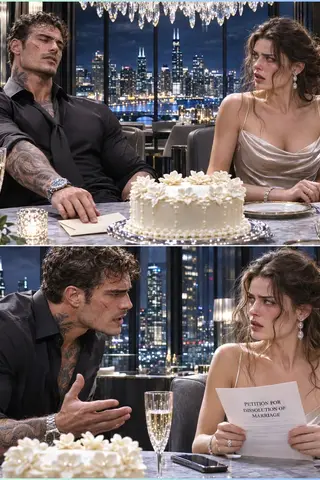
 He Served Me Divorce Papers Over Anniversary Cake... Then He Remembered Who My Father Was
Chapter 2
The Awakening
The chill of the November air hit Laurel like a physical blow the moment she stepped out of the revolving glass doors of the tower onto Michigan Avenue. The city buzzed with the frantic energy of late-night commuters, yellow cabs splashing through the melting slush along the curb, and the neon glow of storefronts bleeding into the wet pavement. For the first time in ten years, she walked down this street as a single woman—or at least, a woman on the precipice of an entirely different life.
Her phone buzzed continuously in her pocket. Wesley. Then another text, likely from a frantic number two asking if the coast was clear. She pulled the device from her coat, silenced the ringer with a single decisive tap, and tossed it into her bag.
For a decade, her entire existence had revolved around managing the subtle, fragile ego of Wesley Brandt. She had downplayed her own background, kept her family name discreet in social circles, and poured her energy into restoring forgotten architectural landmarks across the Midwest—old theaters, crumbling libraries, and historic community hubs that society had discarded. She loved breathing new life into things people had given up on. It was a cruel irony, she realized as she flagged down a passing cab, that she had spent years trying to restore a broken marriage with a man who was already rotting from the inside out.
"Where to, miss?" the driver asked through the partition, his breath fogging the rearview mirror.
"The Drake Hotel, please," she said, her voice steady. She didn't want to go back to the penthouse. Every square foot of that minimalist, designer-furnished glass box smelled like Wesley’s ambition and Ainsley’s cheap vanilla perfume—a scent she had noticed lingering on his collar three weeks ago but foolishly dismissed as static cling from an elevator ride.
As the cab wove through the downtown traffic, Laurel leaned her head against the cool glass window and finally allowed herself to breathe. The numbness that had protected her inside the restaurant was beginning to thaw, replaced not by grief, but by a sharp, crystal-clear clarity. Wesley thought he had orchestrated a masterclass in corporate maneuvering. He believed he had outsmarted her, locking down his assets, securing his company, and engineering a clean break that left him looking like the aggrieved, hard-working visionary while painting her as the distracted, detached wife.
He had forgotten one vital detail. Or rather, he had chosen to ignore it because it didn't fit into the narrative of self-made brilliance he liked to project to his wealthy investors.
When Wesley met Laurel at age twenty-eight, she had introduced herself simply as Laurel Fenwick, a passionate preservationist working for a city non-profit on a modest stipend. Wesley had been a hungry, mid-level project manager desperate to break into commercial real estate development. He had fallen in love with her intellect, her poise, and the quiet confidence she carried into every room—though he later came to view that same confidence as a threat to his dominance.
What he had never bothered to investigate too deeply—and what Laurel had deliberately kept in the background to prove she could make it on her own merit—was the rest of her lineage. The Fenwick name wasn't just a footnote in Chicago history; it was woven into the very bedrock of the city's infrastructure, banking, and real estate dynasties. Her grandfather had built half the commercial hubs downtown before Wesley was even born, and her father, Graham Fenwick, still commanded absolute loyalty and terror in boardrooms across the nation.
Wesley had spent years sneering at old money, calling it stagnant and uninspired, preferring his own aggressive, modern hustle. But hustle without foundation was just noise. And tomorrow morning, that noise was going to meet a very immovable object.
Arriving at the historic hotel, Laurel checked into a quiet suite overlooking the lake. The room was warm, filled with the classic, understated elegance of dark wood and heavy velvet drapes—a stark contrast to the sterile, white-lacquered minimalism of her former home. She poured herself a glass of ice water, walked over to the tall windows, and looked out at the dark expanse of Lake Michigan.
Her phone buzzed again against the nightstand—a missed call from an unknown number, followed by an email notification. It was a digital copy of the formal petition sent directly by Wesley’s lead counsel, demanding an expedited signature and mediation by the end of the week. They were rushing her. They wanted it wrapped up before the holidays so Wesley could announce his new corporate partnership—and his new domestic arrangement—without the distraction of a messy public trial.
Laurel opened her laptop, bypassed the divorce documents for a moment, and opened her contacts. She scrolled past old college friends, historical society board members, and architectural contacts, stopping on a single, unpretentious entry labeled simply: Dad.
She hadn't called him in two weeks, mostly because Wesley always complained that her family gatherings made him feel like an intern being evaluated by a senior partner. Graham Fenwick had never liked Wesley. He hadn't thrown him out or made dramatic scenes; he had simply looked the ambitious young man dead in the eye ten years ago and asked a single question that Wesley had laughed off as old-fashioned cynicism: Does he love you when nobody important is watching?
Laurel pressed the call button. It rang twice before a deep, gravelly voice answered immediately, as if he had been waiting by the phone all night.
"Laurel?" her father’s voice rumbled through the speaker, carrying the unmistakable weight of a man who owned his world. "It’s past midnight. Is everything all right?"
For the first time since she stepped out of that restaurant, Laurel felt a sudden lump form in her throat. The armor cracked just a fraction.
"No, Dad," she whispered, her voice trembling slightly. "It’s not."
On the other line, the ambient sound of shuffling papers stopped instantly. The silence that followed was absolute. When Graham Fenwick spoke again, all the warmth vanished, replaced by the cold, razor-sharp steel of a patriarch whose daughter had just been wronged.
"Tell me what he did."
The End









