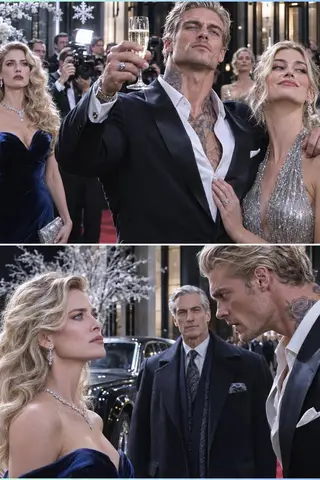
 He Publicly Humiliated His Wife on the Red Carpet
Chapter 7
The Corner Table at Chinatown
By 7:30 PM, the neon lights of Philadelphia’s Chinatown were casting long, vibrant reflections of red and gold across the damp pavement.
The Golden Phoenix was an unassuming little restaurant tucked between a traditional herbalist and a bakery that sold sweet bean buns. It had red vinyl booths, linoleum floors that had seen forty years of steady foot traffic, and the best handmade dumplings in the commonwealth.
It was also where Audra and Hudson had eaten their first meal together twelve years ago, sitting on overturned milk crates before they could afford kitchen chairs.
Audra sat alone in a corner booth near the back, a steaming pot of jasmine tea and two white paper takeout boxes resting on the Formica table.
The door chime jingled softly.
A man walked into the restaurant, shaking a light drizzle of rain from the shoulders of a cheap, off-the-rack trench coat.
It wasn’t Julian.
It was Hudson.
He looked thinner. The sharp, arrogant edge in his posture had softened into something brittle and defensive. His hair was slightly grayer at the temples, and he didn’t carry the expensive leather briefcase or the custom tailored swagger that had once defined him.
He stopped near the front counter, looking around the small dining room as if he had wandered into the wrong dimension.
Then he saw her.
Audra didn’t wave. She didn’t look away. She simply poured a cup of tea and waited.
Hudson hesitated, his jaw tightening. For a second, pride flared in his eyes—the old, stubborn instinct to turn around and walk back out into the rain. But pride required an audience, and here, no one was watching. No cameras were flashing. No reporters were holding microphones.
Slowly, heavily, Hudson walked across the linoleum floor and slid into the vinyl booth opposite her.
For a long moment, neither of them spoke. The restaurant’s old overhead fan hummed a steady, rhythmic tune.
“You look different,” Hudson finally said, his voice lower and rougher than she remembered.
“I’m breathing,” Audra replied simply.
Hudson let out a dry, humorless breath, looking down at his own empty hands. He looked small under the harsh fluorescent lights.
“I lost the apartment,” he said, almost to himself. “The bank took the car. The board... they didn't even let me clear my personal emails before they locked the server.”
Audra took a quiet sip of her tea. “You didn't lose the company, Hudson. You lost a monument to your own ego. There’s a difference.”
Hudson winced as if she had struck him. He looked up, his eyes searching her face for the woman he thought he knew—the quiet, compliant wife who had stood in his shadow for a decade without asking for applause.
Instead, he found a stranger. A woman whose roots ran deeper than any tower he had ever tried to build.
“Why didn’t you tell me?” Hudson whispered, the question breaking through the last of his armor. “Back then... when we started. Why did you let me play the visionary? Why didn't you tell everyone that the Vane estate was funding the whole thing?”
Audra set her teacup down on the saucer. The small clink sounded very clear in the quiet booth.
“Because in the beginning, Hudson, I thought love meant giving someone else the steering wheel so they could feel strong,” she said, her voice completely steady. “I thought building something together meant letting one person take all the credit while the other held the foundation together.”
She leaned forward slightly, her gaze locking onto his.
“I was wrong about that. But you were wrong about something much worse.”
Hudson swallowed hard. “What?”
“You thought strength was the noise you made on stage,” Audra said softly. “You never realized that the people who actually build the world are the ones who make sure the roof doesn't cave in when the storm hits.”
Hudson sat back against the vinyl seat, the fight completely drained out of him. The man who had once demanded that photographers keep shooting his humiliation was gone, leaving behind only an ordinary man realizing the magnitude of his own mistake.
He looked down at the takeout boxes on the table.
“Are those...?”
“Pork dumplings,” Audra said, sliding one of the white boxes across the formica toward him with a pair of wooden chopsticks resting on top. “Same as the first night.”
Hudson stared at the box for a long time. His fingers twitched, hesitating, before he finally reached out and pulled the container toward him.
He didn’t say thank you. He didn’t need to.
Audra watched him for a quiet moment, then turned her gaze toward the front window where the neon signs of Chinatown glowed brightly through the rain.
The performance was over.
Now, finally, real life could begin.
The End









