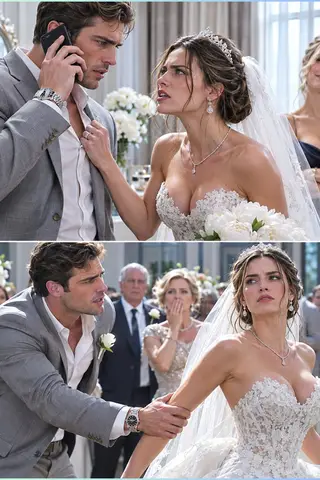
 He Left Me Standing At The Altar For 45 Minutes Over A Locked Car
Chapter 43
The Seismic Paradox
For the next seventy-two hours, the penthouse became a high-tech fortress of engineering ingenuity. Floor-to-ceiling whiteboards were covered with hydrodynamic vectors, fluid friction equations, and bio-mimetic geometry.
Marcus worked seamlessly at my side, handling the financial viability models, energy export calculations, and supply-chain logistics with the effortless mastery that had made him a titan of global enterprise. Between dense structural analyses, he would brush his fingers against mine, ensuring I stayed nourished, pouring fresh tea, and grounding me with an affectionate glance that spoke louder than words. We were not merely a couple; we were an unstoppable force.
"Look at the natural movement of the manta ray," I murmured late on the third night, rotating a 3D computational model on my tablet. "Nature never fights water with rigidity. Rigidity breaks. Flexibility disperses."
"Explain it to me, my genius," Marcus said, resting his chin lightly on my shoulder, his arms circling my waist as we studied the display.
"Instead of Kuroda’s massive concrete wall," I began, zooming into the entrance of Tokyo Bay, "we create an interlocking archipelago of floating, semi-submerged bio-mimetic caissons—what I’m calling the *Izanagi Matrix*. Each module is shaped like an inverted aerodynamic hydrofoil, anchored to the bedrock via flexible carbon-nanotube tension legs equipped with magneto-rheological dampeners."
Marcus’s eyes widened with immediate comprehension. "The tension legs absorb the seabed liquefaction without passing the stress to the surface structures."
"Exactly! And when a tsunami wave enters the bay, the inverted hydrofoils use the kinetic wave energy itself to activate subsurface turbine gates. The wave’s own power forces millions of gallons of water into subterranean deceleration vortices beneath the platforms, driving high-capacity generators while reducing the wave height from forty feet to a harmless two-foot swell."
"It doesn't just stop the tsunami," Marcus breathed, a dazzling smile spreading across his handsome face. "It harvests the disaster to generate gigawatts of clean, renewable energy for the entire city of Tokyo."
"And the surface platforms form a modular, self-sustaining floating district," I added, turning in his arms with flushed cheeks. "Parks, residential towers, research laboratories, and vertical farms that rise and fall effortlessly with the tides."
"It’s breathtaking, Ivy," Marcus said softly, his voice full of pride. "It will revolutionize maritime urban planning for the next two centuries."
He pulled me into a fierce, passionate kiss that made the exhaustion of three days vanish in an instant. Just as we caught our breath, the overhead lights in the penthouse flickered, and the primary server screens in our mobile laboratory suddenly flashed crimson.
Celia rushed into the room, her laptop open. "We have an unauthorized breach on the Vance-Sterling encrypted cloud node. Someone is attempting an active exfiltration of our hydrodynamic simulation models."
***
The End









