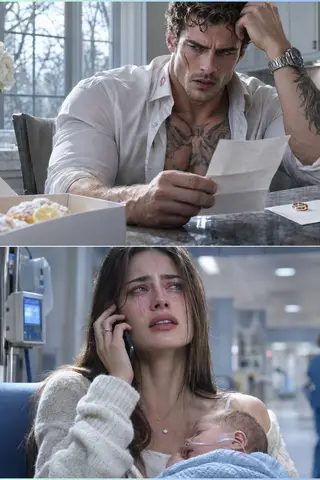
 He Left His Wife Alone with a Sick Newborn for a Mountain Trip with His Mistress
Chapter 11
The Echo of a Fragile Peace
For four months, the quiet rhythm of their reconstructed life felt almost sacred. The new house in Brookline smelled of lemon oil, beeswax, and the buttery vanilla of the teething biscuits Claire baked on Sunday afternoons. Noah was walking now—clumsy, triumphant little dashes across the Turkish runner in the hallway, his hands thrown skyward as though defying gravity by sheer willpower alone. Every time his small, sturdy feet carried him into Adrian’s open arms, Adrian felt a visceral pang of gratitude so fierce it bordered on physical ache.
He had cut his surgical schedule by thirty percent. He declined invitations to keynote lectures in Chicago and Zurich. When his colleagues at Massachusetts General whispered in the scrub room about Adrian Vance sidelining his career trajectory, he felt no sting, no regret. He was home by five-thirty. He bathed his son, scrubbed strained carrots off the wallpaper with quiet patience, and sat opposite Claire over dinners cooked together in a kitchen free of shouting.
Yet trust, Adrian learned, did not heal like bone. When a fracture mended under a cast, the calcium deposit formed a callus stronger than the original skeletal matrix. Human hearts, however, healed more like deep scar tissue—dense, inelastic, hypersensitive to changes in barometric pressure.
Claire loved him; she kissed him before he left in the mornings, leaned into his embrace on the sofa, and wore the platinum band with quiet grace. But her eyes still flickered with a microsecond of alarm whenever Adrian’s phone buzzed on the granite island. If he stayed twenty minutes late because an aortic valve repair threw an unexpected rhythm disturbance, she would answer his call on the first ring, her voice polite, level, but coiled with an ancient, breathless dread.
"I’m stepping into the scrub room now, Claire," he would say immediately, bypassing small talk to offer coordinates, timeline, and reassurance. "I’ll be out by six-fifteen. In the car by six-thirty."
"Okay," she would reply softly. "Be safe. Noah and I will wait for you."
One rainy Tuesday in late March, Adrian finished an uneventful three-vessel bypass. As he walked toward his departmental locker to change out of his green scrubs, Dr. Marcus Higgins, the chief of cardiothoracic surgery, intercepted him near the administrative bridge.
"Adrian," Marcus called out, his silver hair neatly combed, his expression polite but carrying that subtle, institutional wariness administrators perfected. "A courier dropped this off at the front desk for you an hour ago. Marked personal and confidential."
Marcus handed him a thick, manila envelope. There was no return address. Just Adrian’s name, printed in crisp, laser-cut black font.
Adrian took it, thanking his mentor with a casual nod, but as soon as his fingers pressed against the paper, a cold prickle of unease rippled across the back of his neck. Inside was a rigid cardboard sleeve. He walked into his private office, closed the heavy mahogany door, and slid his thumb beneath the gummed seal.
Inside was a single glossy photograph and a folded piece of paper.
Adrian pulled out the photograph. The breath left his lungs in a sharp, jagged gasp.
It was taken from behind the tree line at the Stowe mountain lodge fifteen months ago. It showed Adrian standing on the snow-dusted timber deck, a glass of bourbon in his hand, laughing as Julianne Mercer wrapped her arms around his neck. But it wasn't the image of his unforgivable betrayal that turned his blood to ice water.
Stapled to the back of the photo was a second document: an itemized medical billing statement from a private clinic in upstate Vermont, dated the very day Noah had turned blue in his crib in Boston.
And written across the bottom in neat, purple fountain-pen ink were eight words:
*You didn’t leave alone, Adrian. We need to talk.*
The End









