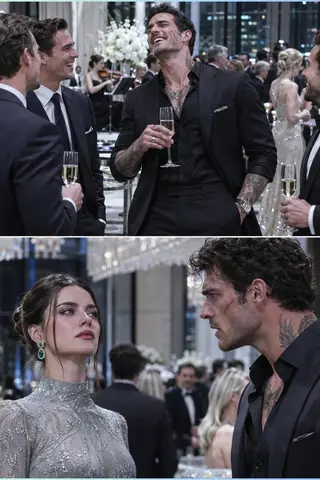
 He Left His Wife Alone on Their Anniversary for a High-Society Gala
Chapter 1
The Ten-Year Ghost
The silence in the kitchen felt heavier than the ticking wall clock. Leah stood beside a dining table set for two, the candles slowly burning down between untouched plates, a bottle of Cabernet breathing beside two crystal glasses, and a six-inch chocolate cake with Happy Ten Years written across the top in white frosting. It was 7:43 p.m. on their tenth wedding anniversary when Mason finally called to tell her not to wait up.
Mason hadn't asked what she was doing. He hadn't even remembered what day it was.
“I'm heading to the Bellweather,” he said over the background sound of city traffic, his voice sharp with the brittle urgency of a man who lived perpetually on the edge of ambition. “Big industry gala. Investors, founders, people from the coast. It could be a good night for Vance Systems.”
Leah looked across the table at the empty chair. “The Bellweather Gala?”
“Yeah.” A brief pause, followed by a slight shift in his tone. “You didn't make plans, did you?”
She almost laughed. It was a dry, humorless sound that caught in her throat. “I made dinner.”
“Leah.” He sighed her name the way people sigh when they find an unexpected, unpaid medical bill in the mail. “I told you weeks ago this quarter was brutal.”
“No. You told me you were busy.”
“Same thing.” Behind him, a car horn blared, sharp and impatient.
Leah reached out, her fingertips brushing the edge of the cardboard cake box. “Could I come with you?”
The silence that followed was worse than a quick refusal. It was a suffocating void filled with unspoken calculations.
“Mason?” she prompted softly.
“It isn't really your kind of evening.”
Leah stared at the steady flame of the nearest candle, feeling the warmth against her skin. “My kind?”
“You know what I mean. It's business. People talk deals all night. Half the room is trying to impress the other half.”
“I can talk to people.”
“I know you can talk to people.” He sounded irritated now, the thin veneer of patience wearing away. “I'm saying you wouldn't enjoy it.”
That wasn't what he was saying. For ten years, Leah had learned to decode the complex syntax of her husband's dismissals, hearing the exact sentence hiding underneath the sanitized one: You wouldn't fit. You wouldn't know anyone. You would embarrass me. You belong at home.
Slowly, she lowered herself into her chair, the velvet cushion absorbing her weight. “You've never taken me to one.”
“Because you hate crowds.”
“I don't hate crowds.”
“You always say you're tired.”
“Usually after cooking for twelve people,” she murmured, though she knew he wasn't listening.
Another pause stretched between them, thin and brittle. “Leah, please don't turn this into something tonight.”
Tonight. Of all nights in the calendar year. She looked back down at the chocolate cake. There were ten individual candles standing upright in the frosting. She had lit every single one of them herself, watching the matches burn down until her fingers grew warm.
“Go,” she said quietly.
“I knew you'd understand.”
That was always the problem. She always understood.
Mason hung up without another word. Leah sat alone at the table while the expensive ribeye steak slowly cooled on her plate, losing its steam, turning grey at the edges. At 8:07 p.m., she reached across the table and blew out the anniversary candles, one by one, until the thin spirals of white smoke vanished into the dim room.
At 8:11 p.m., her phone lit up on the tablecloth.
The number wasn't saved in her contacts anymore, but she knew the sequence of digits by heart. She hadn't deleted it because she hated the person behind it. She had deleted the name because seeing Dad appear on her screen had become too painful to bear every time she looked at her phone.
The message contained only eleven words:
I'm speaking at the Bellweather tonight. Come home when you're ready.
Leah read it twice. Then a third time, letting the words settle into the quiet room. Her father had never begged her to come back. He had never threatened Mason, never sent corporate lawyers to dig into her husband's background, and never reminded her of what she had so willingly walked away from a decade ago.
Ten years earlier, when she walked into her father’s expansive corner office at Sterling Consolidated and announced she was leaving the corporate world to marry a struggling young software founder named Mason Vance, Gideon Sterling had sat behind his heavy mahogany desk for nearly a full minute without speaking. He hadn't raised his voice. He hadn't slammed his hand down. He had simply looked at her through his wire-rimmed glasses with eyes that had seen empires rise and fall.
Then he had asked three questions.
“Do you love him?”
“Yes,” she had answered, young and fiercely certain.
“Does he love you?”
“I think so.”
Her father's eyes had narrowed slightly. “That wasn't my question.”
She had been twenty-five then, arrogant enough to believe that romantic love could conquer any disparity as long as you worked hard enough and stayed loyal enough. “Yes,” she had insisted.
Dad had leaned back in his leather chair, folding his hands over his stomach. “And does he know who you are?”
“He knows enough.”
That single answer had bothered her father more than anything else. Mason knew her father owned businesses—he assumed they were local retail chains or mid-level commercial real estate. He knew Leah had studied finance in college. He knew she had worked in corporate strategy before they met, handling presentations and spreadsheets.
What Mason didn't know—what Leah had deliberately hidden to protect the delicate ego of a man building his first startup—was that Gideon Sterling controlled one of the largest privately held industrial, tech-investment, and shipping conglomerates in the country.
He didn't know that Leah had entered university at seventeen, graduated near the top of her class in financial engineering, and joined Sterling Consolidated before her twenty-first birthday. He didn't know that at twenty-three, she had single-handedly negotiated the hostile acquisition of a multi-state manufacturing network that seasoned Wall Street veterans said couldn't be bought.
He didn't know that prominent business magazines had once featured her face on their covers, calling her Gideon Sterling's obvious and ruthless successor.
And he certainly didn't know that when Mason proposed, she had voluntarily walked away from all of it, handing her resignation letter to her father without a single tear.
Mason had told her over a cheap diner dinner one rainy Tuesday night that he wanted a simple, peaceful marriage. “No corporate competition,” he had said, smiling across a basket of fries as he wiped tomato sauce from his thumb. “I deal with cutthroat sharks all day long. When I come home, I just want peace. I want a partner who leaves the office behind.”
At twenty-five, Leah had heard romance, safety, and devotion. At thirty-five, sitting in a quiet, empty dining room with cooling steak, she finally understood the true warning hidden underneath his words.
She stood up abruptly, her chair scraping against the hardwood floor, and carried her phone upstairs.
At the very back of their walk-in closet, pushed deep behind rows of winter coats Mason never touched because he hated cold weather, stood a walnut cabinet built directly into the reinforced drywall. She had not opened it in nearly nine years.
Leah reached into the pocket of her house robe, retrieved a small brass key from an old velvet pouch, and slid it into the brass lock. With a soft click, the heavy door swung open.
Inside hung a ghost life.
Tailored Armani jackets in charcoal and navy. Crispy white silk blouses with immaculate collars. A floor-length black evening dress that commanded attention without trying. And hanging beside them were three bespoke business suits from a time when she had strode into high-stakes corporate boardrooms without ever second-guessing whether she belonged at the head of the table.
On the upper wooden shelf sat a heavy dark mahogany box. Leah reached up, her fingers dusting the smooth surface, and lifted the hinged lid.
Resting inside on a bed of faded black velvet was her Sterling family ring. It featured a magnificent rectangular emerald surrounded by a precise halo of baguette diamonds—understated, elegant, and entirely unyielding until the light hit its facets and flashed a blinding green fire. Her father had slipped it onto her finger the day she officially joined the executive board of Sterling Consolidated.
Beneath the ring lay a single, glossy photograph.
Leah picked it up, her thumb tracing the corner of the frame. In the picture, she was twenty-three years old, standing outside a towering glass skyscraper in downtown Manhattan, wearing a sharp white pantsuit while press photographers and reporters crowded around her with microphones.
She looked fearless.
Maybe she hadn't been entirely fearless on the inside, she thought, staring at her younger self's steady, unblinking gaze. But she had always known how to pretend, how to command a room, and how to win.
She sat directly down on the plush carpet of the closet floor, holding the photograph tightly against her chest until her legs grew completely numb.
Ten years.
Somewhere along the winding road of marriage, she had made a fatal error: she had mistaken making endless, quiet sacrifices for being deeply loved. She had stopped traveling because Mason complained he hated eating alone in their apartment. Then, once she stopped traveling, he started working late anyway.
She had stopped attending major industry events because he told her that married life was far more peaceful without all that networking noise. Then, as soon as she withdrew, he began attending them alone, building a public persona where he was the sole visionary, the solitary hero fighting the tech world's battles.
She had learned his mother's exact pie recipes. She remembered every single one of his VIP clients' wedding anniversaries and children's birthdays. She picked up his dry cleaning, organized charity dinners, sat beside him on the sofa while he rehearsed his keynote speeches, quietly rewrote his business emails when he was too angry to sound professional, and rubbed his aching shoulders while he complained for hours that nobody in the venture capital world understood how much pressure he carried on his narrow shoulders.
Her mind drifted back four years, to a cold Tuesday night when Vance Systems had nearly run out of operating cash and was two weeks away from bankruptcy. Mason had come home at two in the morning, pale and shaking, and sat directly on the kitchen floor with his head in his hands.
“I might lose everything,” he had whispered, his voice cracking with genuine terror. “All of it is gone.”
Leah had sat beside him on the cold tile floor until sunrise, comforting him, holding his hand, telling him things would work out. Three days later, a mysterious private investment and venture fund called Alder Ridge quietly extended his failing company a multi-million-dollar emergency financing package that completely saved it from liquidation.
Mason had celebrated for a full week, treating it like divine intervention, bragging to his business friends about his incredible luck.
He never knew the truth. Alder Ridge didn't belong to some faceless Wall Street syndicate; it was a shell investment vehicle that Leah had created quietly, funding it entirely with the private trust and stock dividends her late grandmother had left her. She had never told her father about the rescue, and she had never told Mason. She had done it because she didn't want her husband to ever feel emasculated or rescued by his own wife.
A year after that near-collapse, Vance Systems miraculously landed the single largest enterprise logistics contract in its entire corporate history—a deal that put them on the map. Mason had thrown a lavish rooftop party for his executives, soaking up the applause.
He never knew that Leah had spent two solid months working behind the scenes through an anonymous corporate intermediary after discovering that Vance Systems' original proposal was fundamentally flawed and legally toxic. She had rewritten their entire compliance strategy and fed the corrected specs to the client's procurement director under an alias.
There had been dozens of things just like that over the decade. Small corrections. Strategic introductions. Quiet warnings. Doors miraculously opening right before Mason reached them.
He genuinely believed that raw momentum and his own brilliant hustle had finally found him.
And Leah had happily let him believe it, because she thought she was simply supporting the man she loved with all her heart.
Now, sitting alone on the dark floor of her closet in grey cotton sweatpants while her husband attended another high-society gala without her, she finally saw the bitter, twisted cruelty in what she had done.
She hadn't just supported him. She had cocooned him in a padded bubble, smoothing away every sharp edge of reality so thoroughly that he had been left completely incapable of seeing her worth. She had made it impossibly easy for him to believe he had never needed her at all.
Her phone buzzed violently against the carpet.
It was a second text message from her father: The keynote starts at nine. Your seat in the VIP gallery is open if you remember how to wear that emerald ring.
Leah’s throat tightened, a sudden surge of adrenaline washing away the numbness in her limbs. She looked down at the photograph in her hand, then up at the black evening dress hanging silently in the walnut cabinet.
She stood up, walked to the hangers, and reached for the zipper.
The End









