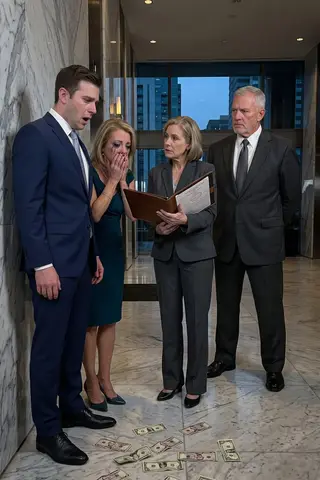
 He Handed His Wife 12 Dollars After Her C-Section and Told Her to Take the Bus
Chapter 1
The Twelve-Dollar Exile
The sterile fluorescent lights of St. Vincent’s Hospital in Manhattan hummed overhead, casting a cold, clinical glow over the stainless-steel bassinet. Five days after major abdominal surgery, every breath I took felt like a deliberate act of defiance against the jagged wire of stitches hidden beneath my hospital-grade binder. Yet, the physical pain was nothing compared to the hollow, freezing realization settling deep into my chest.
“Julian,” I whispered, my voice trembling slightly as I clutched five-day-old Liam tightly against my chest. “You seriously want me to take the public bus home?”
Julian checked his luxury Swiss wristwatch, a gold-plated status symbol I had bought him for our second anniversary. His expression was a portrait of bored inconvenience, the kind of look a man gives a delayed flight rather than his post-operative wife and newborn child.
“My mother’s reservation at Le Bernardin is in forty minutes,” Julian replied, his voice flat and devoid of warmth. “Don’t make this difficult, Elena. We have a tightly packed schedule today, and you know how Beatrice gets when her seating isn’t prompt.”
Without waiting for an answer, he reached into his designer jacket pocket, pulled out a wad of cash, peeled off two crumpled bills, and pressed them roughly into my palm.
Twelve dollars.
Behind him, parked right in the yellow fire lane, sat the matte-black armored Cadillac Escalade. It wasn’t just any SUV; it was a custom-reinforced, high-security vehicle my father had gifted me before our wedding to ensure my safety in the city. Over the past year, Julian had gradually hijacked it, driving it to his venture capital meetings because he claimed it gave him “critical executive presence” in front of prospective investors.
Just then, the glass hospital doors slid open, and my mother-in-law, Beatrice, glided out. She was draped in a cashmere trench coat and oversized designer sunglasses, looking like she was stepping onto a yacht in Monaco rather than visiting a maternity ward.
“Our table is locked in, Julian. Are we moving or standing here all day?” she complained, her voice sharp like broken glass.
Julian immediately rushed forward, opening the passenger door with a deferential flourish. A bitter laugh caught in my throat. In three years of marriage, he hadn’t opened a car door for me once—not even during the final agonizing months of my pregnancy when my ankles were swollen and I could barely tie my own shoes.
“I need Liam’s diaper bag,” I said, shifting the baby carefully.
Julian sighed heavily, yanked the heavy canvas bag from the back seat, and dropped it unceremoniously at my feet on the concrete sidewalk. When I instinctively bent forward to pick it up, white-hot pain ripped across my lower abdomen, blurring my vision and making my knees buckle.
A passing labor-and-delivery nurse gasped, rushing forward to grab my arm. “Ma’am, do not bend like that! You just had major abdominal surgery! Your internal sutures are still healing!”
Julian rolled his eyes, throwing his hands up in theatrical exasperation. “Can everyone stop turning this into a medical emergency? She’s fine. She’s just being dramatic for attention.”
Something inside me didn’t snap; it went completely, terrifyingly still. The fragile illusion I had maintained for three years—the desperate hope that beneath Julian’s narcissistic exterior lay a loving husband and father—shattered into dust.
Minutes later, the luxury SUV roared away from the curb, its tinted windows hiding Beatrice, Julian, and his visiting sister as they laughed over some private joke. I stood alone on the Manhattan sidewalk, holding a newborn infant against my chest, watching my own car disappear into traffic.
A city bus rumbled to a halt beside me with a loud hiss of pneumatic brakes. The driver caught sight of my bright pink hospital wristband, took one look at my pale face and the baby bundle, and immediately lowered the wheelchair ramp. Before I could even step forward, an elderly woman in a woolen coat stood up, her eyes swimming with sudden tears.
“Here, sweetheart. Take my seat. You shouldn’t even be walking,” she insisted, gently guiding me inside.
Their absolute strangers' kindness hurt infinitely worse than Julian’s calculated cruelty. As the gray autumn landscape of Manhattan blurred past the smudged bus windows, I finally stopped making excuses for my life.
For three years, Julian believed I was simply Elena Sterling, the quiet, unassuming daughter of an ordinary retired government clerk. I had deliberately allowed that misunderstanding to take root when we first met at a downtown bookstore. I wanted a man who loved me for who I was, not for the inescapable weight of my father’s name or the terrifying power that came with it.
My father was General Marcus Sterling. For four decades, he had commanded combat divisions, directed Pentagon intelligence operations, and walked the corridors of absolute national power. Growing up, I learned early that people treated me differently the moment they knew who my father was. When I met Julian, I wanted a pure, uncorrupted love.
Dad had warned me on my wedding day, his granite-gray eyes piercing through my veil: “Make sure you learn who a man truly is before you tell him who you are, Elena. Character reveals itself when power is unequal.”
Now, I knew.
I slipped my hand into my handbag, pulled out my encrypted satellite phone, and dialed a private, ten-digit number I hadn't used in five years.
It rang only once before a deep, gravelly, battle-tested voice answered.
“Elena?”
“Dad… I need help.”
Instantly, the ambient noise in my father’s background vanished, replaced by absolute, focused stillness. His voice dropped an octave, sharpening into commander mode. “Where are you?”
“On a city bus. In Manhattan.”
A heavy, suffocating silence hung over the line. Then, very slowly: “Tell me everything.”
I didn’t cry. With a cold, steady voice, I laid it all out—the C-section, Julian taking my vehicle, dumping me on the sidewalk, the twelve dollars in my palm, and the bus ride home.
When I finished, my father asked one simple, devastating question: “Do you want to go back to him?”
I looked down at Liam, who was sleeping peacefully against my chest, completely safe and unaware of the storm brewing around us.
“No,” I whispered, the word solid as granite. “I want to leave him.”
“Then you’ve left him,” my father replied without a single second of hesitation. “What about the SUV?”
“It’s legally mine.”
“Entirely,” Dad confirmed. “And the Tribeca penthouse?”
“Let your attorney explain that to him.” Then, my father’s tone turned glacial. “Do not warn Julian about anything. Sit tight.”
At the very next bus stop in Midtown, two sleek black civilian sedans pulled up smoothly behind the bus. A woman in a sharp dark suit stepped out, boarded the bus, and walked straight to my seat. With practiced, respectful efficiency, she helped me down, shielding me from the autumn wind.
Inside the waiting sedan, everything I and my son could possibly need was already waiting: a certified medical-grade newborn car seat, heated bottled water, cashmere blankets, and a secure communications tablet.
My phone buzzed in my lap. A text message from Julian.
Mom wants the SUV tomorrow too, so don’t make plans.
Another message popped up a second later.
And clean up the penthouse before we get back tonight. My major venture capital investors are stopping by for drinks. Don't embarrass me.
I stared at the screen, watching the glowing words of a man who still believed he held all the cards. I didn’t reply. Instead, my driver pulled away from the curb, heading not toward the empty, loveless duplex in Tribeca, but toward a secure family brownstone overlooking the East River—where a top-tier pediatric nurse and my father’s personal physician were already waiting to care for us.
The End









