 He Framed A Sheriff For A $4,600 Watch
Chapter 4
The Identification
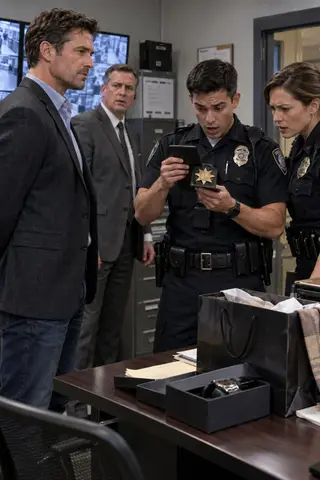
Officer Evan Ruiz flipped open his notebook, fumbling slightly with his ballpoint pen as his youthful eyes darted between Martin and me.
“Let’s stick to the basics for right now,” Ruiz stammered, clearing his throat to steady his voice. He looked at me, adopting the formal, slightly rehearsed interrogation tone taught at the academy. “Step one. I need your full legal name and government-issued identification, sir.”
I reached slowly into my back pocket, pulled out my leather cardholder, and extracted my North Carolina driver's license, holding it by the very edge between two fingers before handing it across the metal desk to the rookie.
Ruiz took it, squinting down at the printed text under the harsh fluorescent glare.
“Nathan Cole,” he read aloud.
“Yes,” I said.
Ruiz looked back up from the plastic card, his eyebrows furrowing slightly as his mind tried to process protocol. “Alright, Mr. Cole. Standard department procedure for any detained individual where weapons or safety checks are concerned—do you currently have any weapons on your person?”
The room went completely still. Even Martin Pike stopped his restless shifting.
“Yes,” I replied without blinking.
Both police officers reacted instantly. It wasn't panic—it was the well-drilled, muscle-memory reflex of street cops whose survival depended on split-second threat assessments. Officer Ruiz’s hand twitched downward, hovering instinctively within two inches of his molded black holster. Sergeant Hayes shifted her stance immediately, pivoting slightly to her left to create a tactical angle of coverage, her hand resting firmly and securely over her service weapon.
“What kind?” Hayes demanded, her voice cutting through the stale air like a razor blade.
“Semi-automatic handgun,” I replied, keeping my hands completely open, empty, and resting palms-up on the edge of the metal desk. “Concealed carry, right side hip holster. Fully licensed, legally registered in North Carolina.”
Ruiz looked at Hayes for a split-second authorization nod. Hayes gave a tiny, subtle tilt of her chin.
“Keep your hands exactly where they are, Mr. Cole,” Ruiz instructed, his voice trembling ever so slightly with adrenaline. “Officer Ruiz is going to step in and secure the weapon temporarily for everyone's safety. Do not make any sudden movements.”
“Understood,” I said quietly. “Do whatever you need to do.”
Ruiz stepped close, his boots squeaking softly against the linoleum floor. With practiced, careful movements, he unsnapped my jacket, unbuckled the retention strap of my custom leather holster, and lifted my Sig Sauer compact pistol cleanly from its resting place. He immediately checked the chamber, dropped the magazine, secured the weapon, and tucked it safely into his own temporary gear pouch before stepping back.
Sergeant Hayes immediately pulled out her radio, calling in the serial number to dispatch for a quick run.
“Run it through state and federal databases,” Hayes instructed into her shoulder mic.
Ten seconds passed. The radio crackled softly with static.
“Dispatch to Unit Four-Twelve. Serial number clear. Valid carry permit, fully registered, zero warrants, zero infractions. Clean record across the board.”
Hayes lowered her radio, exhaling a quiet breath of relief. But as she looked back up at me, her professional confusion deepened. An armed man with a spotless background, carrying a concealed weapon while shopping in an upscale department store, didn't match the profile of a desperate retail thief who needed to boost a four-thousand-dollar watch.
Martin Pike, however, chose to interpret the moment through the lens of his own desperate narrative. A smug, victorious smile spread across his face. He leaned forward, resting both hands triumphantly on the desk.
“Well, there you have it, Sergeant,” Martin interjected, his voice dripping with malicious satisfaction. “An armed individual wandering our high-end sales floor, caught red-handed in possession of stolen luxury merchandise, refusing cooperation, and making bizarre accusations. The picture is completely clear. You have probable cause for a felony arrest right here.”
Sergeant Hayes looked at Martin, then back at me. She didn't look entirely convinced by Martin’s polished speech, but the physical evidence—the watch case sitting brazenly on top of my bag—tied her hands according to standard on-scene protocol.
“Mr. Cole,” Hayes said quietly, her professional demeanor remaining entirely polite despite the tension. “Given the physical recovery of the merchandise and store testimony, I’m required to place you in temporary custody while we sort out the evidence at the precinct. Turn around and place your hands behind your back, please.”
I didn't like it. Every fiber of my sixteen years in law enforcement screamed against submitting to unjust restraint. But resisting a lawful detention order—even an erroneous one—on a suspect premise only played directly into Martin’s hands.
“Fine,” I said, keeping my voice level.
I turned around, facing the cinderblock wall, and extended my wrists behind my back.
Officer Ruiz stepped forward, pulling a pair of standard-issue steel handcuffs from his utility belt. His hands were shaking slightly—not out of malice, but from the raw, youthful nervousness of a rookie officer about to cuff an armed, mature man in a high-tension corporate dispute. The steel cuffs clicked shut around my wrists, biting with a cold, unforgiving tightness that I had spent my entire career putting on other people, never expecting to wear myself.
The End









