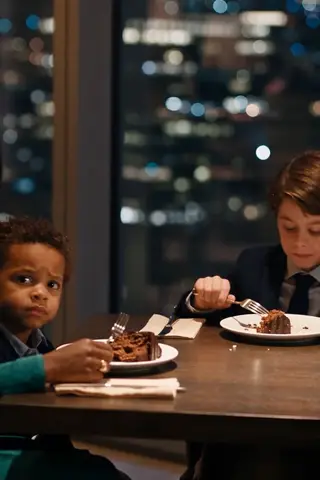
 He Divorced Her Because He Thought She Was Sterile
Chapter 1
The Cold Kitchen and the Frozen Goodbye
The snow falling outside our penthouse window in downtown Chicago didn't fall softly like it did in holiday films; it drove hard, slashing against the thick glass pane with an icy fury that matched the atmosphere inside our kitchen. I stood by the marble island, the heat of the ceramic mug warming my freezing hands, though nothing could thaw the chill that had settled deep into my chest over the past eighteen months. Luca Moretti, the man I had loved since we shared a single cramped apartment above a bakery in Pilsen, sat at the opposite end of the room. He wasn't looking at me. His eyes were fixed on the glowing screen of his tablet, tracking the pre-market movements of a tech startup he was planning to absorb into Moretti Global.
Back when we met, Luca wore frayed denim and carried a stack of architectural textbooks under his arm, dreaming of skyline towers he would one day own. I had worked two jobs at local cafes to pay for our groceries while he finished his degree. I had bled, sweated, and sacrificed alongside him, believing that every hurdle we cleared brought us closer to the family we both desperately craved. But empires change men. As the skyscrapers rose bearing his name, and as glossy magazine profiles hailed him as a visionary, cold, unstoppable tycoon, the warmth between us calcified into polite silence.
The silence had a root cause: a nursery that remained empty.
For five agonizing years, we had tried. I tracked ovulation cycles with the precision of a military tactician, swallowed horse-pill vitamins that left a metallic taste in my mouth, and sat through endless sterile appointments beneath the glaring white hum of hospital fluorescent lights. Every negative pregnancy test felt like a small, private funeral, a silent reminder of my body's apparent failure. Luca had accompanied me to the first few fertility appointments, holding my hand with a grip so tight it left red indents on my skin. But as his business meetings grew longer and his corporate responsibilities expanded, he stopped coming. Then, the whispers started. Someone he trusted—probably one of his sycophantic board members or a rival trying to destabilize him—planted a poisonous, insidious idea into his head.
Maybe the problem wasn't mutual. Maybe the problem was me.
Luca never accused me to my face with harsh words; that would have required an emotional confrontation, and Luca preferred corporate efficiency. Instead, he simply extracted himself from our life. Late nights at headquarters became standard procedure. Unnecessary business trips to New York and London multiplied. Conversations shrank to monosyllabic updates about schedules, and our nights together turned into long, suffocating silences separated by a gulf of empty mattress space. When I cried in the dark, staring up at the plaster ceiling, he would roll over, look profoundly uncomfortable, and find an excuse to check his emails in the study.
That snowy Chicago evening, the erosion finally reached its structural bedrock. Luca set his tablet down on the kitchen island with a soft click, stood up, and looked at me with eyes as gray and devoid of warmth as Lake Michigan in January.
“I don't think I love you the way I used to, Nia,” he had said, his voice entirely level, stripped of any inflection that might suggest regret.
My tea trembled in my hand, the brown liquid sloshing dangerously against the ceramic rim. But I refused to let him see me shatter. I set the cup down with agonizing precision, my fingers steadying through sheer willpower.
“Is this really what you want, Luca?” I asked, my voice barely a whisper above the howl of the wind outside.
He didn't hesitate. He didn't look down. He just nodded. “Yes.”
So I packed two suitcases that very night, walked out into the swirling blizzard, and never looked back. What Luca never knew—what I kept locked away in the deepest vault of my heart—was that barely two weeks after the divorce papers were finalized, a doctor in a quiet clinic on the North Side looked at my chart, blinked in utter astonishment, and told me I was pregnant. Not just with one child, but with twins. My body hadn't been broken; the immense, suffocating stress of a dying marriage and toxic psychological pressure had simply locked my system down. When the pressure was removed, nature quietly reclaimed its course.
I made a choice that night in the clinic. I wouldn't call him. I wouldn't tie myself to a man who had discarded me the moment fertility statistics turned unfavorable. I would raise my children on my own terms, with my own strength. But secrets in Chicago—especially secrets involving a man as powerful as Luca Moretti—have a funny way of waiting in the dark, biding their time until fate decides to rip the curtains wide open.
The End









