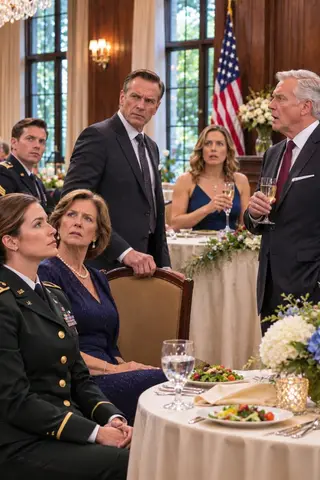
 He Called My Army Uniform 'Costume Dress-Up' In Front Of 200 Guests
Chapter 1
The Toast at Table Nine
The crystal chandelier above the grand ballroom caught the flickering light of a hundred candles, casting a warm, golden glow over the sea of expensive dresses and tailored tuxedos. Two hundred guests had gathered at the St. Clair Hotel to celebrate the wedding of Sierra, my younger sister. Every detail of the reception radiated opulence—from the cascading floral arrangements imported from the Netherlands to the ice sculpture shaped like a pair of intertwined swans near the entrance.
At the head table, bathed in the prime spotlight, sat my parents and the glowing bride, Sierra, alongside her new husband. I, however, was seated far away at table nine, tucked into a shadowy corner right beside the swinging kitchen doors. The rhythmic thumping of heavy carts, the clatter of silverware, and the sharp shouts of hurried waiters formed a chaotic background track to my evening.
I smoothed the front of my Army dress blues. At forty years old, I had worn this uniform through deserts, command centers, and bureaucratic battlegrounds that would have broken ordinary men. The medals pinned to my chest told a quiet story of sacrifice, midnight briefings, and leadership under fire. Yet, sitting in that chair, I felt microscopically small.
My father, Douglas, stood at the microphone, holding a crystal flute of champagne. His face was flushed with wine, pride, and the self-satisfied glow of a man who believed he had won at life. He looked out over the crowd, his smile broad and infectious.
"As many of you know," my father boomed into the microphone, his voice echoing off the mahogany walls, "raising two daughters is no small task. But let's be honest with ourselves tonight. I only have one real daughter. The other one ran off to play dress-up in a uniform."
Laughter rippled through the room. It wasn’t a malicious chuckle at first; it was the polite, obligatory amusement of guests eager to please their host.
Sierra smiled into her champagne glass, her eyes sparkling with quiet triumph. She had inherited our father's knack for social positioning, knowing exactly how to bask in the warmth of his affection while leaving everyone else out in the cold.
Beside me at table nine, our fifteen-year-old cousin Leo leaned over, his face twisted in genuine disgust. "That’s messed up," he whispered, his knuckles white as he gripped his napkin. "He didn't have to say that. You're sitting right here."
I folded my hands neatly in my lap, keeping my spine straight and my expression completely neutral—the exact posture the service had drilled into me during my earliest days at basic training. Emotion under control. Situation assessed. Threat contained.
"It's fine, Leo," I murmured, my voice steady, devoid of the tremor that threatened to betray my chest. "Just eat your dinner."
For eighteen years, my father had told anyone who would listen that I had thrown my life away. When my peers were climbing corporate ladders or buying suburban homes, I was packing a rucksack and boarding a C-17 transport plane. He believed I had run off to play soldier simply because I couldn't cut it in the real world. He knew I was in the Army, of course—my enlistment papers and subsequent commission were public facts he couldn't entirely hide. But he had never once bothered to ask what I actually did. He assumed I was a grunt in the mud, a nameless face marching in formation.
He had no idea about the briefing rooms beneath the Pentagon. He had no idea about the strategic logistics networks I designed, the classified operations I oversaw, or the immense responsibility resting on my shoulders every single day.
I picked up my water glass, stared at the condensation rolling down the side, and counted the minutes. Two more hours. The cake cutting. The final send-off. Then I could slip away into the night, get into my car, and drive back to a world where my contributions were measured by competence rather than a father's approval.
But my aunt Coraly, sitting two seats down from me, was not laughing. Her eyes flashed with sudden anger as she stared across the room toward the head table.
"Douglas," she muttered loudly enough for everyone at our table to hear, "that's your girl right there in the blues. That's a nice uniform."
My father paused, his smile tightening slightly as he caught her eye. He waved a dismissive hand in the air.
"That's a costume, Cory," my father laughed into the mic, leaning back against the podium. "She plays army, Sierra plays life."
That was the moment the temperature in the room seemed to drop. Across the ballroom, at a table reserved for military personnel who had flown in for the event, an abrupt and heavy silence fell. A young sergeant stopped mid-sentence, his fork hovering inches from his plate. He looked from my father, who was chuckling with a few sycophantic guests in the front rows, over to my uniform at table nine. His expression shifted instantly from polite celebration to absolute, unyielding stone.
And then, at table three, a silver-haired man in an impeccably tailored dark suit slowly set down his linen napkin.
The End









