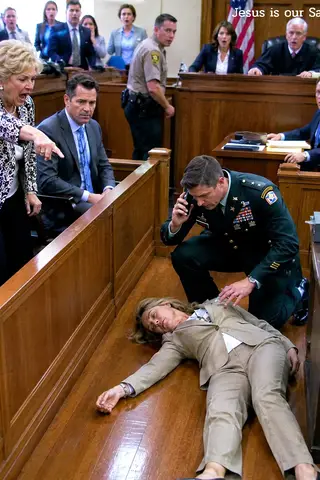
 HE CALLED IT FAKE: She Collapsed In Court Crying For Help
Chapter 2
The Secret Diagnosis
The sirens wailing outside the courthouse windows sounded like the distant howling of wolves closing in on a wounded deer. I drifted in and out of consciousness, caught in a suffocating twilight zone where I could hear every word spoken around me, yet I was entirely powerless to respond or move a single muscle.
"She's stabilizing for now, but her blood pressure is bottoming out at eighty over forty," a paramedic’s voice barked as the gurney rattled violently down the courthouse corridor.
I felt the cold rush of outdoor air hit my face, followed by the heavy, sterile scent of rubbing alcohol and diesel exhaust inside the back of the ambulance. Through heavy, half-opened eyelids, I saw Colonel Aaron Carter climb into the vehicle right behind the medical team, completely ignoring the protests of the courthouse security guards who tried to block him.
"I am riding with her," the Colonel told the lead paramedic, flashing a military ID card alongside his medical credentials. "I am a senior trauma surgeon currently stationed at Walter Reed, consulting on regional public health anomalies. This patient's presentation matches a clinical profile I’ve studied extensively. You want me in this rig."
The paramedic didn't argue. He slammed the back doors shut, and the ambulance lurched forward, throwing me against the padded straps.
"Can you hear me, Elena?" Colonel Carter leaned over me, his voice remarkably steady and warm beneath the harsh overhead LED lights of the ambulance. He gently slipped an oxygen mask over my nose and mouth, the cool rush of air instantly easing the desperate burning in my chest. "My name is Aaron. You're safe now. You're out of that courtroom."
I managed to twitch my index finger—a microscopic movement, but enough.
"Good girl," he murmured, adjusting the intravenous line he had somehow managed to start while the vehicle was moving at fifty miles an hour. "Just keep breathing. We’re going to St. Jude’s Memorial. I’ve already called ahead to the head of toxicology. They’re going to run a full comprehensive panel the second the wheels stop."
Toxicology.
The word echoed in my brain like a hammer striking an anvil. For months, I had believed I was losing my mind. I had gone to four different doctors complaining of chronic dizziness, sudden memory lapses, muscle weakness, metallic tastes in my mouth, and terrifying nights where my heart felt like it was trying to claw its way out of my throat. Every single one of them—prompted by medical records provided by Daniel's high-priced legal team—had diagnosed me with severe conversion disorder, major depressive psychosis, and Munchausen-adjacent hypochondria.
Daniel had even staged an "intervention" six months ago, bringing in a psychiatrist he personally hired who confirmed that my symptoms were entirely psychosomatic, brought on by the stress of our impending divorce. I had started doubting my own sanity. I had looked at my seven-year-old daughter, Lily, and wept, terrified that I was truly a broken, dangerous mother who couldn't even trust her own nervous system.
And all the while, Patricia had smiled sweetly across dinner tables, handing me herbal teas specially brewed to "calm my nerves," and reminding me how fragile my health had always been since Daniel and I got married.
When the ambulance finally backed into the emergency bay of St. Jude’s Memorial Hospital, a trauma team was already waiting at the sliding doors. They swarmed the gurney like a pit crew, wheeling me through double doors marked AUTHORIZED PERSONNEL ONLY.
Colonel Carter walked right beside the bed, holding my chart and rattling off medical jargon with a crisp authority that made the civilian emergency doctors nod in immediate respect. "Initial presentation: profound peripheral cyanosis, severe bradycardia alternating with tachycardia, non-responsive motor functions, and localized neurotoxicity indicators. Suspect heavy metal or targeted neurotoxin ingestion—organic mercury, thallium, or a potent acetylcholinesterase inhibitor. Get a full blood, urine, and hair follicle screen immediately. Priority one."
"On it, Colonel," the ER attending physician said, wheeling me into Trauma Room 3. "Who authorized you to—"
"Federal medical oversight directive," Aaron cut him off smoothly, flashing a badge that made the attending doctor swallow hard and drop any further questions. "Treat her as if she's a high-value contamination case. No outside visitors. No phone calls. And guard her medical records with your life."
As they transferred me to the cold hospital bed and began sticking multiple IV lines into both of my arms, I caught a glimpse of Aaron standing just outside the glass partition. He was pulling out his phone, his face set in a grim, hard line. He wasn't just a random military doctor who happened to be sitting in a courtroom.
He was investigating something much bigger. And somehow, my body crashing on that courtroom floor had just blown the lid off a nightmare I was only beginning to understand.
The End









