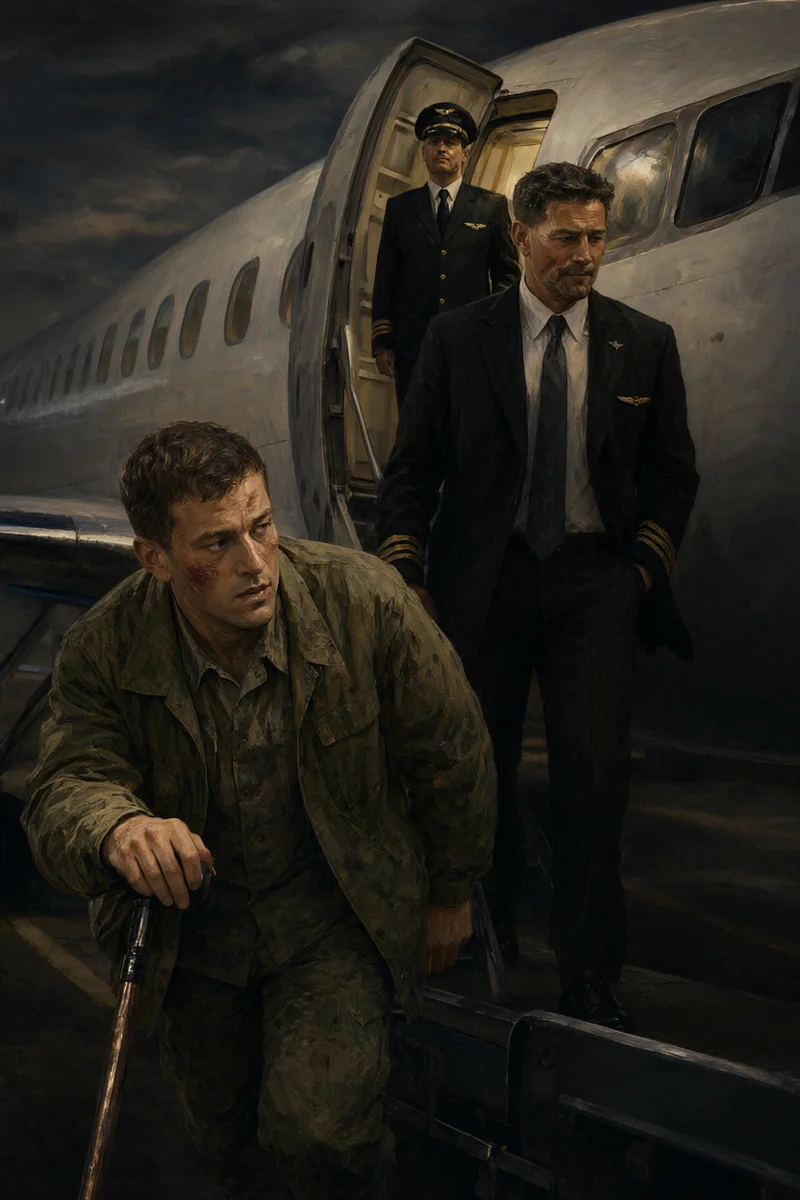
 Gate Agent Demoted a Wounded Vet for a Rich Businessman
Chapter 3
The Weight in the Carry-On
I slowly stood up, pushing off the armrest while a familiar shock of white-hot pain radiated from my left knee socket down into the titanium joint. I balanced carefully on my cane, letting out a slow, controlled breath so Maya wouldn't hear me grunt.
With my free hand, I reached up into the overhead bin and retrieved our single canvas carry-on bag. To the passengers staring at us from rows three and four, it was just an ordinary piece of luggage. To me, it was a sacred vessel. Inside, tucked safely beneath a spare change of clothes and Maya’s favorite stuffed rabbit, sat a small, matte-black aluminum urn sealed with industrial adhesive.
Inside that container was Elena.
For two years, she had lived on our mantelpiece in a quiet corner of the living room, surrounded by framed photographs of her smiling at the beach, her hair tangled in the salt spray. But today was the day the journey ended. Today was the day we were keeping our promise. And now, we were being unceremoniously banished to the rear lavatory-adjacent rows of the aircraft like second-class citizens in our own country.
As I hoisted the bag against my chest, the metal zipper caught the light. Dangling from the side pocket was my old unit’s challenge coin—heavy, bronze, engraved with the crossed rifles and the emblem of the infantry division that had carried me through the worst days of my life. Right beside it, tucked neatly into the clear plastic sleeve of my luggage tag, was my Department of Veterans Affairs ID card, showing my service-connected disability rating and the ribbons I had earned before the desert took my leg.
“Daddy, let me carry my backpack,” Maya whispered, slipping her small pink backpack over her shoulders.
“I’ve got you, bug,” I said, offering her my hand.
We began the long, humiliating walk down the narrow aisle. The cabin was unnaturally quiet. You could hear the muffled hum of the auxiliary power unit and the squeak of my rubber cane tip against the industrial carpet. Some passengers turned their heads away, unwilling to meet my eyes, burdened by the awkwardness of witnessing corporate discrimination in real-time. Others watched with a mild, detached curiosity, as if we were actors in a play they hadn’t quite tuned into.
Mr. Henderson was already settling into our first-class seats, hanging his designer suit jacket over the hook and accepting a pre-takeoff glass of sparkling water from the flight attendant without so much as a glance in our direction.
The gate agent stood near row ten, arms crossed, watching us retreat to make sure we didn't cause any more trouble for his VIP passenger.
“Row twenty-eight is right back there, sir,” the agent called out, his voice echoing in the cabin. “Enjoy your flight.”
I didn't answer. I just kept walking, keeping my shoulders back, determined not to let Maya see her father cower. We reached row twenty-eight—a cramped middle and window seat right next to the rear galley, where the smell of stale coffee and cleaning fluid hung heavy in the air.
Just as I reached up to stow our bag in the overcrowded overhead bin, a sharp, authoritative voice cut through the cabin noise from the front.
“Hold on.”
It wasn't the gate agent. It was a voice that commanded entire rooms without raising its pitch.
The cockpit door at the front of the aircraft clicked open.
The End









