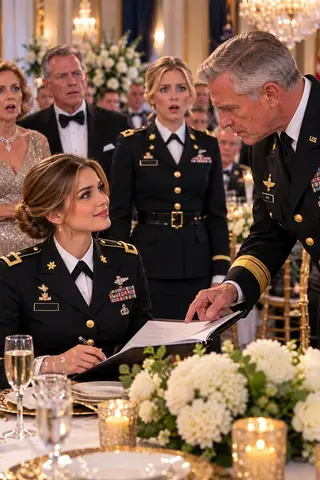
 Family Slams 'Useless' Daughter at Major Sister's Party
Chapter 1
The Shadow of the Golden Child
The crystal chandeliers of the Sea Pines Grand Club in Hilton Head glittered like fallen stars, casting a warm, golden glow over a room filled with politicians, defense contractors, and high-ranking military officials. It was supposed to be a night of triumph, a celebration of ambition, and above all, a public coronation for my younger sister, Emily. At barely thirty years old, Emily had just been pinned as a Major in the United States Army—a feat that my parents treated as if she had single-handedly won a world war.
My mother, Eleanor Whitlock, stood near the center stage, her champagne glass raised high before the string quartet had even finished its first song.
“To Major Emily Whitlock,” she announced proudly, her voice carrying across the glittering ballroom with practiced elegance. “The pride of our family, our shining star, and proof that dedication and brilliance still pave the way in this world.”
More than a hundred guests applauded warmly, the sound of clapping hands echoing off the white linen tables and floral arrangements of orchids and lilies. Cameras flashed relentlessly, capturing every angle of my sister, who stood proudly beside the stage in her immaculate Army dress uniform. The gold oak leaves on her shoulders gleamed under the stage lights, her ribbons were aligned with geometric precision, and her hair was pinned into a flawless twist.
“Major before thirty,” a retired colonel remarked, shaking his head in genuine awe. “That’s remarkable, Emily. Most officers don't sniff that rank until their mid-thirties.”
“Washington is going to hear your name a lot,” another wealthy defense executive added, leaning in as if sharing a secret. “Keep moving up at this rate, and you’ll be running a command before you know it.”
Emily placed a hand against her chest and gave her practiced, modest little laugh—the exact one she had practiced in front of the mirror since she was a lieutenant. “I’ve just been blessed with incredible mentors and unwavering family support.”
I stood near the heavy oak ballroom entrance, holding a glass of plain water, nearly choking on a sip as I listened to her speech. While Emily basked in the adulation, I wore a simple dark blazer, black slacks, and plain heels—exactly where my mother had instructed me to remain. I hadn't wanted to come, but family obligations in our social circle were mandatory, especially when an appearance of a united, successful front was at stake.
Then, my mother’s sharp eyes spotted me standing near the edge of the shadows. Her radiant, hosting smile tightened instantly into a pinched grimace. She excused herself from a group of state senators and rushed across the polished hardwood floor toward me.
“Megan,” she hissed, gripping my forearm tightly enough to leave bruises. “Thank goodness you dressed normally. At least you didn't try to steal any attention tonight.”
I looked down at myself, feeling a bitter knot form in my stomach. “It’s a blazer, Mom. It’s professional.”
“I know, sweetheart,” she whispered, her voice venomous under her breath. “But listen very carefully. There are very important people here tonight—investors, generals, people who actually matter.” Her eyes darted anxiously toward several defense executives mingling near the buffet. “Please, for once in your life, don't start explaining your little office job.”
I stared at her, the insult stinging despite how many times I had heard variations of it over the years. “My little office job?”
She sighed impatiently, brushing an invisible speck of dust off my lapel. “People hear military paperwork and assume clerical work, data entry, filing. I don’t want anyone confusing whatever obscure desk job you do with Emily’s actual accomplishments. It’s embarrassing for the family.”
There it was. The exact script of my entire life.
Emily was the soldier. Emily was ambitious. Emily was going places.
And I? I was simply the older daughter who “worked somewhere in defense administration” and never brought home enough exciting stories, medals, or promotions for my mother to brag about at her weekly country club luncheons. To my parents, I was the quiet, invisible background character in Emily’s grand narrative of success.
My mother leaned in even closer, her perfume choking out the scent of the lilies. “Stay near the back tables. Maybe beside the service hallway if you can manage it. Smile if someone accidentally speaks to you, but remember: tonight is not about you. It is entirely about your sister.”
The floral arrangements around us suddenly smelled sickeningly sweet. My mother had always loved expensive, superficial things arranged just right to distract people from whatever hollow reality lay underneath.
I offered a flat, lifeless smile. “If that’s what you want, Mom.”
“It is,” she said briskly, patting my arm patronizingly as if I were a child who needed supervision before hurrying back toward Emily and the flashing cameras.
For nearly forty minutes, I kept my promise. I stayed glued to the back of the room, watching people fawn over my sister. My parents only introduced me to passing acquaintances when social convention forced them to, rattling off a dismissive, “Oh, this is our older daughter, Megan, she handles administrative logistics in Washington,” before immediately turning the conversation back to Emily’s glowing military career.
I didn't care. Or at least, I told myself I didn't care. I knew things about the defense sector—things that people in this glittering ballroom couldn't even begin to fathom. But letting them wallow in their ignorance was far more entertaining.
Until the heavy mahogany ballroom doors swung open wide at the opposite end of the hall.
The ambient chatter of a hundred elite guests instantly dropped by half. Every senior officer standing near the stage snapped to attention, their posture locking into rigid military bearing.
A four-star general strode into the room.
The End









