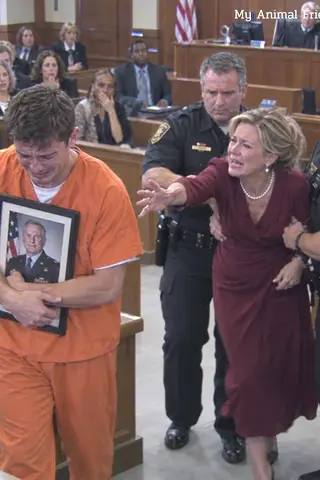
 Ex-Convict Returns Home After 3 Years in Prison Only to Find His Stepmother Living in Luxury and Claiming His Father is Dead
Chapter 1
The Weight of 1,095 Days
The heavy iron gates of Oakwood Prison swung open with a grinding groan that I had rehearsed in my nightmares for three long years. Every single one of those 1,095 days had been measured not by the rising and setting of the sun, but by the relentless ticking of a clock that seemed designed to strip away every shred of my dignity. I stood there on the cold asphalt of the highway shoulder, clutching a battered canvas backpack containing a few changes of prison-issued clothes, a cheap plastic comb, and eighty-four dollars in gate money. My hands, calloused and pale, trembled continuously—a lingering physical reflex from the endless hours spent in solitary confinement and the crushing anxiety of an isolation cell.
When the police hauled me away three years ago, I had been a promising junior executive at Dennis Industries, my father’s manufacturing empire. I had a clean record, a bright future, and a life built on the rock-solid foundation of my father’s trust. Then came the audit. Missing funds, forged signatures, and a trail of digital footprints that pointed directly to my workstation. Despite my frantic protests, my tearful pleas, and my desperate assertions of innocence, the court didn't see a confused, grieving son; they saw a privileged brat who had gambled away corporate assets. My own defense attorney had advised me to take a plea deal to avoid twenty years, assuring me that cooperation would bring leniency. I refused the plea, fought tooth and nail, and was handed a mandatory three-year sentence anyway.
The worst part wasn't the concrete walls, the violent inmates, or the institutional food. It was the silence from my father.
For the first six months, I wrote him letters every single week. I poured my soul onto cheap lined paper, begging him to believe me, reminding him of the values he had instilled in me since I was a little boy. None of them were answered. Then, my stepmother, Reagan, sent a brief, chilling typed letter through her attorney: “Camden Dennis is too heartbroken and ill to read your lies. Do not write again. Consider yourself dead to this family.”
That blow had nearly broken me. But as I stood on the highway with the cool morning wind whipping through my hair, I forced myself to take a deep, steadying breath. My father, Camden Dennis, was a proud, fiercely principled man. He had built his company from a single workshop into a multi-million-dollar corporation through sheer grit. I refused to believe that he could abandon me so completely without looking me in the eye. That was why, the moment I was released, I didn't go to a halfway house or a cheap motel. I took a Greyhound bus straight back to Silver Lake, straight back to the sprawling estate where I had grown up, fueled by the desperate, burning hope that my father was waiting inside to welcome his son home and help me piece my broken life back together.
The bus dropped me off three blocks from the estate, and I walked the remaining distance, my worn sneakers hitting the familiar pavement. But as I turned the corner onto Elmwood Drive, my heart plummeted like a stone dropped down a bottomless well. The Silver Lake house, once a sanctuary of warm brick, ivy-covered walls, and meticulously tended rose gardens, looked entirely foreign. The classic colonial red brick had been slathered over in an ultra-modern, sterile shade of matte charcoal gray. My mother’s beloved rose bushes—which my father had sworn to protect after her passing—had been ripped out, replaced by aggressive geometric rock landscaping and towering boxwood hedges. A luxury white SUV and a sleek red sports sedan sat in the widened, freshly paved driveway. Even the heavy oak front door, with its brass knocker shaped like a lion's head, had been replaced by a forbidding, minimalist black steel door featuring a digital keypad lock.
It was the same physical structure, but every ounce of warmth, history, and soul had been meticulously scrubbed away.
Panic fluttered in my chest, hot and suffocating. I hurried up the steps, ignoring the trembling in my knees, and pounded my fist against the new door. I didn't knock like a polite guest dropping by for tea; I pounded with the frantic, desperate rhythm of a drowning man punching the surface of the water. I needed answers. I needed my father.
After what felt like an eternity, the electronic lock clicked, and the door swung open.
Reagan stood in the doorway, framed by a foyer that looked like it had been ripped straight out of an interior design magazine. She wore an emerald-green silk dress that hugged her slender frame, complemented by heavy pearl earrings and a makeup job so immaculate it looked like armor. Her expression wasn't one of shock, fear, or even guilt. It was an expression of supreme, unbothered annoyance, as if a stray dog had wandered onto her porch and tracked mud across her pristine white tiles.
“You got out sooner than I expected,” she said, her voice dripping with a casual, chilling indifference.
I ignored the insult, my eyes darting past her shoulder, desperate for a glimpse of the familiar living room. “Where's my father?” I demanded, my voice cracking slightly.
Reagan sighed, a theatrical, heavy sigh that suggested she was dealing with a deeply irritating toddler. She leaned against the doorframe, crossing her arms over her chest.
“He was buried a year ago, Finnley. Cancer. Fast. Painful. It's over now. You missed the service.”
The words hit me with the physical force of a sledgehammer to the gut. The world around me spun violently on its axis, the sky tilting, the sounds of distant traffic turning into a dull, roaring static in my ears. For a terrifying second, my lungs refused to expand. I grabbed the edge of the doorframe to keep from collapsing, my knuckles turning stark white.
“And... and nobody told me?” I choked out, tears stinging the backs of my eyes as hot fury mingled with suffocating grief. “Nobody even tried to let me see him one last time? I was his only son!”
A faint, cold smile touched the corners of Reagan’s perfectly painted lips. It was a smile that didn't reach her eyes, a smile of absolute, ruthless triumph.
“Finnley, please,” she said softly, tilting her head. “You were in prison for stealing millions from your own father’s company, nearly driving him into bankruptcy before his health failed. Do you honestly think he wanted a convicted felon ruining his final days or his funeral? He made his peace, cut ties with you legally and emotionally, and left his affairs in order.”
“I didn't steal anything!” I shouted, the injustice of it all tearing through my chest like jagged glass. “It was a setup! You know it was!”
“You said that during the trial, and the jury didn't believe a single word,” Reagan replied, her voice dropping into a dangerous, icy register. “And neither did your father. Now listen to me very carefully, boy. This house is mine now. The company is mine. Everything your father worked for belongs to me and Carter. You have no home here, no family here, and certainly no inheritance.”
Before I could force my paralyzed vocal cords to form another word, heavy footsteps echoed down the grand staircase behind her. Carter, my stepbrother, appeared in the foyer. He was wearing an expensive cashmere sweater and a smirk that made my skin crawl. Carter had spent the last ten years neck-deep in underground gambling debts, running up massive tabs with loan sharks, yet here he was, looking like a lord of the manor.
“Well, look who decided to crawl out of the woodwork,” Carter drawled, sauntering up beside Reagan and resting a familiar hand on her shoulder. “Did the ex-con come looking for handouts? Sorry, bro, the bank account is dry for you.”
I took a slow, deliberate step forward, my fists clenched so tight my fingernails dug deep into my palms, drawing faint pinpricks of blood. “Let me in,” I whispered, my voice trembling with a terrifying mix of rage and heartbreak. “I just want to see his room. Just for five minutes.”
Reagan’s expression hardened instantly. She didn't budge an inch. “If you take one more step onto this property, I will call the police immediately. With your brand-new criminal record, violation of a private property warning won't end with a slap on the wrist. You'll be back in an orange jumpsuit by tonight.”
She didn't slam the door in my face. Instead, she closed it slowly, deliberately, and with a quiet, polite click that felt infinitely more painful than a violent crash.
I stood there on the porch for a long, agonizing moment, staring at the sleek black steel. I didn't scream, and I didn't kick the door. Three years behind bars had taught me one vital lesson: impotent rage only destroys the person feeling it, while giving your enemies exactly what they want. I wasn't going to hand Reagan the satisfaction of proving I was a dangerous criminal.
There was only one place left on earth where I could find any semblance of truth.
Pinecrest Cemetery.
My father had always told me over Sunday morning coffee that when his time came, he wanted to be laid to rest right beside my mother under the old weeping willow in the historic section of the cemetery. If Reagan was telling the truth about his death, I needed to see his name carved into cold granite with my own eyes to make the nightmare real.
The walk to Pinecrest Cemetery took nearly forty minutes, my legs burning with every step as the late afternoon sun began to dip below the horizon, casting long, eerie shadows across the quiet suburban streets. When I finally reached the wrought-iron gates of the graveyard, the air grew noticeably cooler, thick with the scent of damp earth, decaying leaves, and ancient pine needles. I walked along the winding cobblestone paths, my eyes scanning the weathered headstones, searching for the familiar family plot.
As I approached the old weeping willow tree, an elderly man in a faded green maintenance jacket stepped out from behind a row of towering cypress trees, holding a pair of heavy pruning shears. His posture was slightly stooped, his face lined with deep wrinkles carved by decades of outdoor labor, but his eyes were remarkably sharp and observant.
He stopped directly in my path, blocking the trail.
“Who are you looking for, son?” the old man asked, his voice gravelly and low.
I swallowed hard, wiping a stray bead of sweat from my forehead. “Camden Dennis,” I said, my voice barely audible. “His wife told me he's buried here.”
The old man’s expression didn't show confusion, shock, or pity. Instead, a flash of profound recognition crossed his weathered features, followed immediately by a cautious, protective wariness. He glanced sharply toward the cemetery gates, making sure the main road was empty, before taking a step closer to me.
“You're Finnley... aren't you?”
A violent chill raced down my spine, freezing the blood in my veins. I took a step back, my hands flying up in instinctive defense. “How do you know my name? Who are you?”
The old man looked around once more, then reached slowly inside the breast pocket of his jacket. He pulled out a slightly yellowed, heavy parchment envelope. Across the front, written in my father’s unmistakable, sharp, confident cursive handwriting, were three words: To My Son.
My breath caught in my throat. My knees grew weak.
“Because,” the old groundskeeper whispered, clutching the envelope tightly in his calloused fingers, “your father asked me to give you this if you ever came looking for him. And let me tell you right now, son... your father isn't buried here at all.”
The End









