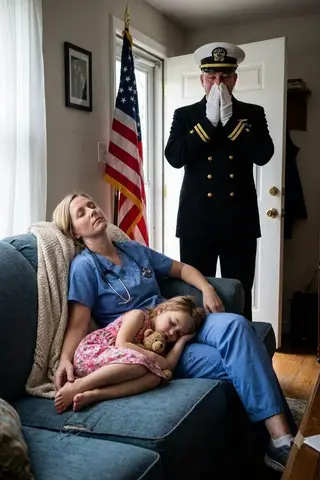
 Elite Special Ops Captain Returns Home to Find a Mysterious Nurse Guarding His Daughter
Chapter 2
The Calm Before the Storm
The transition from the sterile, fluorescent-lit hallway of the pediatric ward to the quiet confinement of room 318 felt like stepping into an airtight vault. Mason gently transferred Ava from his arms back onto the narrow hospital bed, smoothing the thin flannel blanket over her shoulders. She sighed deeply, her tiny hand instantly curling into a fist around the edge of her pillow, anchored by the lingering comfort of the battered plush rabbit Claire had handed off before disappearing down the corridor.
Mason pulled a stiff plastic chair up beside the mattress, sitting down with a heavy sigh that rattled his weary bones. His muscles ached with a deep, bone-deep fatigue, each fiber screaming for sleep, yet his nervous system remained wired on a razor-edge of hyper-awareness. The digital clock on the bedside table glowed in harsh crimson numbers: 1:15 a.m. Outside the small wire-reinforced window of the door, the rhythmic squeak of rubber-soled shoes announced the passing of the night shift nurses, accompanied by the occasional distant chime of an infusion pump running low on saline.
His thoughts drifted back to Claire Bennett.
The scars on her forearm. The tactical sweep of the hallway intersection. The flawless, combat-ready reflex of her hands when she supported Ava’s skull. None of those traits belonged to an ordinary civilian healthcare worker. They belonged to someone who had lived through violence, someone who had operated in shadows where trust was a luxury few could afford. He pulled out his encrypted military smartphone, tapping the screen to bring up a secure browser. Without connecting to public servers, he accessed a private, encrypted database accessible only to high-clearance special operations personnel—a restricted roster of former intelligence assets, contractors, and shadow-war veterans who had quietly vanished from active duty over the past decade.
He typed in Bennett, Claire.
The loading wheel spun lazily against the dark screen, the digital pulse ticking away seconds in the quiet room. After a moment, a stark, unyielding message flashed across the interface: ACCESS RESTRICTED - LEVEL 4 CLEARANCE REQUIRED.
Mason frowned, his thumb hovering over the glass. Level 4 clearance was reserved for black-budget operations, deep-cover intelligence officers, and personnel managed by joint clandestine task forces. The fact that her file was buried behind a titanium-grade firewall confirmed his deepest suspicions: Claire Bennett was not a run-of-the-mill nurse who happened to possess good reflexes. She was a ghost hiding in plain sight, wearing scrubs as camouflage in a civilian hospital.
Why would an operative of that caliber be working a standard night shift in a municipal pediatric ward in San Diego? What kind of ghosts was she running from, and how did her path intersect with a routine children's hospital?
His internal interrogation was abruptly interrupted by the soft click of the door opening an inch.
Mason’s hand instinctively drifted toward his hip, his fingers curling into empty air where his sidearm usually rested before he remembered he was in a civilian hospital wearing civilian clothes. He relaxed his posture as the door swung open to reveal an exhausted-looking resident wearing a white lab coat over rumpled scrubs. The name tag on his lapel read Dr. Kevin Vance, Pediatrics.
“Captain Reed?” the young doctor whispered, stepping cautiously into the dim room. “I’m Dr. Vance. I was on call when you arrived earlier, but I was tied up in trauma.”
“Doctor,” Mason acknowledged quietly, standing up without making a sound to avoid disturbing Ava. “How is she?”
Dr. Vance checked the digital chart attached to the foot of the bed, his brow furrowing slightly in concentration. “She’s holding steady, considering the severity of the double viral pneumonia. Her oxygen saturation is fluctuating slightly, but it’s within acceptable parameters for a post-fever recovery phase. We’ve got her on a low-flow nasal cannula, and her vitals should stabilize further by morning.”
“Should?” Mason caught the hesitation in the doctor's professional cadence.
Dr. Vance offered an apologetic, weary smile. “Pediatric pneumonia is notoriously unpredictable, Captain. Children compensate brilliantly right up until the moment they crash. Her little lungs took a massive hit from the secondary infection while you were deployed. But she’s a fighter. And she’s got a phenomenal care team.”
“Speaking of the care team,” Mason said, keeping his voice carefully neutral. “Nurse Bennett. How long has she been with this hospital?”
Dr. Vance blinked, surprised by the sudden pivot in the conversation. “Claire? Oh, she’s been with us for about eight months. Transferred in from out of state. Why do you ask?”
“Just curious. She seemed... exceptionally competent.”
“Competent doesn't even begin to cover it,” Dr. Vance chuckled dryly, shaking his head. “To be honest with you, Captain, the nursing staff treats her like an anomaly. She doesn't talk about her past, she never takes breaks in the cafeteria, and she can read a crashing monitor across the room before the alarm even sounds. Last month, we had an aggressive, combative father high on synthetics try to breach the maternity ward. Before security could even draw their batons, Claire had him pinned against the drywall in a joint lock so fast nobody even saw her move. She’s... intense.”
Mason’s gaze drifted back toward the dark hallway outside the glass window. “I noticed.”
“Anyway,” Dr. Vance patted the metal railing of the bed gently. “Get some rest, Captain. You look like you’ve been through a warzone.”
“I usually have,” Mason muttered dryly.
The young doctor offered a sympathetic nod, checked the IV drip one last time, and slipped out of the room, closing the heavy door with a soft click.
Mason sank back into the plastic chair, rubbing his tired eyes with his palms. The silence of the room settled over him like a heavy wool blanket, broken only by the steady, mechanical hiss of the oxygen machine and the soft, rhythmic breathing of his sleeping daughter. Despite his exhaustion, his mind raced through tactical scenarios, threat assessments, and unanswered questions. Claire Bennett was hiding a lethal set of skills behind a stethoscope and a ponytail. And yet, she had spent nearly three hours holding a terrified, motherless four-year-old child in a dark hospital alcove, murmuring soft reassurances until the terror subsided.
What kind of warrior possessed that kind of profound, gentle grace?
As the hours ticked away toward 3:30 a.m., the ambient temperature in the room seemed to drop imperceptibly. The mechanical hum of the oxygen pump shifted into a slightly higher pitch, a subtle mechanical whine that barely registered above the threshold of normal noise.
Mason closed his eyes for a brief second, letting his head tilt back against the wall behind him.
It was a fatal mistake for a tired operative.
In the span of a single heartbeat, the monotonous rhythm of the room shattered completely.
Ava let out a sudden, violent gasp—a harsh, tearing sound that instantly ripped Mason out of his exhaustion. He bolted upright, his chair clattering backward against the tile floor.
Ava’s eyes were wide, panicked, and unseeing, her tiny hands clawing frantically at the air around her throat as her chest heaved in desperate, silent agony. The nasal cannula had slipped away, and her lips were already turning an alarming shade of blue.
Pneumonia had just launched its counter-attack. And the battle for his daughter’s life was starting right now.
The End









