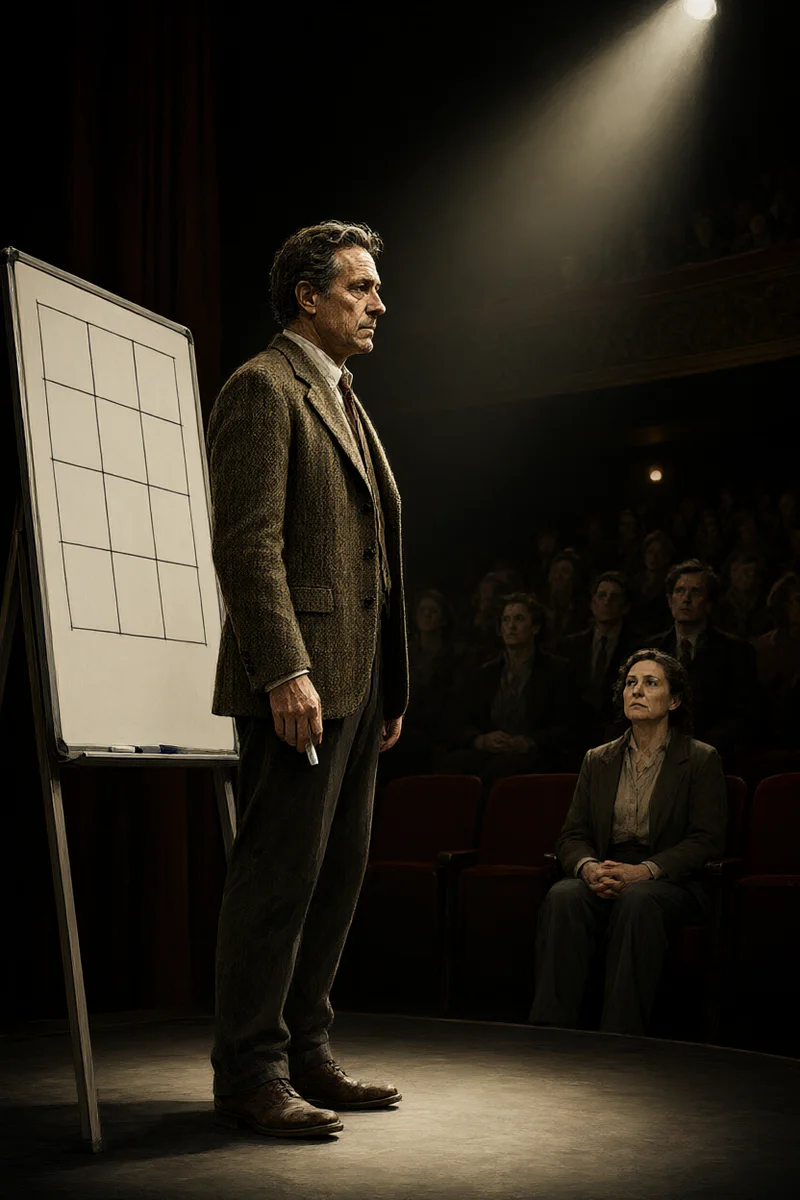
 Seventeen Across
Chapter 3
The Small Door
Helen Okonjo was perhaps forty, with a pencil pushed through a knot of black hair and a tote bag full of proofs. She had chosen a café opposite the bus station where nobody from the Gazette ever went, and she had already ordered two teas.
“I'm not trying to make trouble,” she said before Imogen had sat down. “I want to be clear about that.”
“How did you know?”
Helen took a folder from the tote bag. Inside were printouts of old grids, with clues circled in red pen.
“Clue style, first. Roderick never edited much. He kept a file of favourite clues, and when I read it I kept noticing them. Night duty. Ward rounds. Tea trolleys. The commode clue from 2011 is famous in certain circles.” She smiled slightly. “Your husband teaches geography. I could never find one river.”
“That's not proof.”
“No. This is.” Helen turned a page. “Two weeks ago I found an error in Saturday's grid at eleven on a Tuesday morning. I emailed the house address, the one the cheques go to. A corrected grid came back in thirty-eight minutes.” She tapped the page. “My son's in Year Nine at Wexley High. I looked at the timetable. At eleven on a Tuesday, Mr. Fairweather is teaching 9C about glaciers.”
Imogen laughed. It came out of her without permission, and Helen looked relieved.
“I like the crossword,” Helen said. “I like it more than any puzzle in the region. I don't want to lose it. But your contract renews in January, and the new contract needs the constructor's real name and a signature. I can't put Clement's on it, knowing. I'm not going to say anything to anyone. That's up to you. But I can't sign something false.”
“And the festival?”
Helen's mouth went tight. “I'm on the committee. I voted for the award before I knew. I'm assuming he can't do the live construction.”
“He's been practising.”
“Is he any good?”
Imogen thought of OTTER, alone in its corner, and the nine minutes of breathing.
“You've got until January,” Helen said. “I'm sorry I've made your week worse.”
Imogen went home on the bus and let herself in quietly. Clement was at the kitchen table with something small and beige laid on a tea towel in front of him, like a surgeon's instrument.
“Don't be cross,” he said. “Just hear me out.”
It was an earpiece. A tiny wireless one, the kind sold for people who were hard of hearing, with a matching transmitter the size of a lipstick. He had bought it online for forty pounds.
“You sit in the third row,” he said. “On the aisle. They shout out the words, you work it out in your head, you talk to me very quietly through this. Nobody will see. It's twelve minutes, Immy. Then it's over, and we never have to do this again.”
He held the transmitter out to her across the table.
“Just this once,” he said. “After twenty-two years, I don't think that's very much to ask.”
The End









