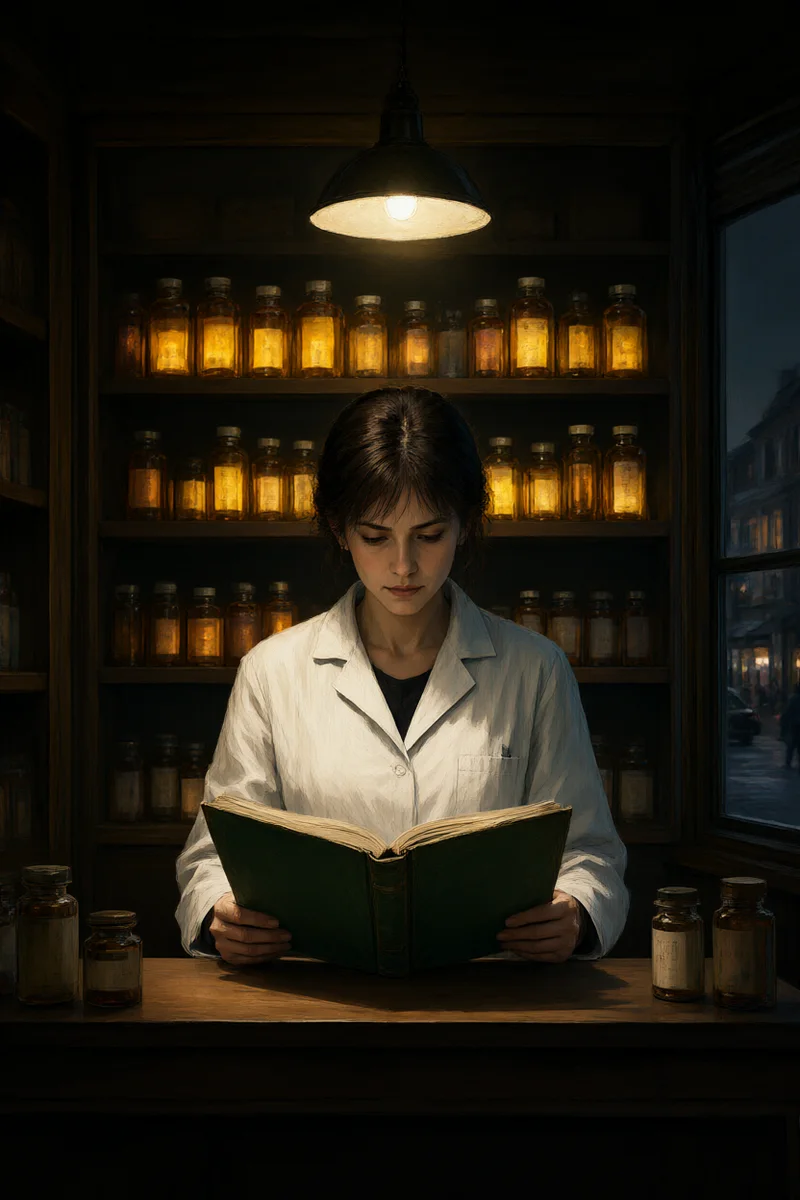
 The Green Book
Chapter 2
Did Not Call
She counted them that night at her kitchen table with a pencil, the way he would have. Two hundred and twelve entries over seven and a half years.
They started slow, three or four a year. A double dose. A drug Abbott Gantry had already stopped. A refill for a patient who had moved to Arizona. By 2018 there was something nearly every week, and the notes got shorter. Wrong strength. Wrong patient. Filled correct. And always, at the end of the line, the same three words. Did not call.
Her father had not been catching the doctor's mistakes. He had been fixing them himself, quietly, at the counter, and handing the right pills across to people who had no idea anything had been wrong. Changing a prescription without the prescriber's say-so. She had learned in her first week of pharmacy school that you could lose your license for that. And for seven years, because of it, nobody in Harlan Springs had noticed that their doctor was going.
Saturday morning she drove out to the Gantry place on the county road. The lawn was cut. The flag was up. Leona Gantry-Hale answered the door in a fleece vest with a dish towel over her shoulder. She had moved back from Omaha two years ago, after her mother passed, to keep house for her father, and she and Nell had been in the same 4-H club in 1993 without ever particularly liking each other.
“He's on the porch,” Leona said. “He's doing the crossword. Be nice.”
Abbott Gantry was in a cane chair with the Omaha paper and a mechanical pencil. He looked up and smiled with his whole face. “Lewis's girl. Sit down. What's a seven-letter word for a brief summary?”
“Synopsis is eight,” Nell said. “Précis is six.”
“Digest,” he said, and wrote it, and it was right. He asked after Bodie's mother, by name, and her hip, by side. He remembered that Nell had played the clarinet. For twenty minutes she sat on that porch in the October sun and could not find anything wrong with him at all.
Then she said, “Doctor, do you remember Ivy Dunwoody's warfarin? This week?”
He frowned pleasantly. “Ivy's on five milligrams. Has been for years.”
“You wrote fifty on Tuesday.”
“I don't believe I did.” He went back to the crossword. “Lewis would have called me.”
“Did he ever? Call you?”
The pencil stopped. He looked out at the cut field beyond the road for a long moment, and when he turned back his face had gone faintly polite, the way you look at a stranger who has your name.
“I'm sorry,” he said. “Who did you say you were with?”
Leona was in the doorway. She had been there the whole time. She walked Nell to her car. The gravel was loud under their shoes. At the car door Leona folded the dish towel very precisely in half, and in half again.
“He has good hours and bad ones,” she said. “Mornings are better. He sees eleven patients a day, Nell. Mrs. Dunwoody can't drive to Kearney. Half of them can't.”
“He wrote her ten times her dose.”
“And you caught it. That's how it works.”
Nell looked at her. “What do you mean, that's how it works?”
Leona put the folded towel in her vest pocket.
“Your father came out to this house in the fall of 2017,” she said, “and sat at my mother's kitchen table and told us both about his green book. We agreed between the three of us. I thought you knew.”
The End









