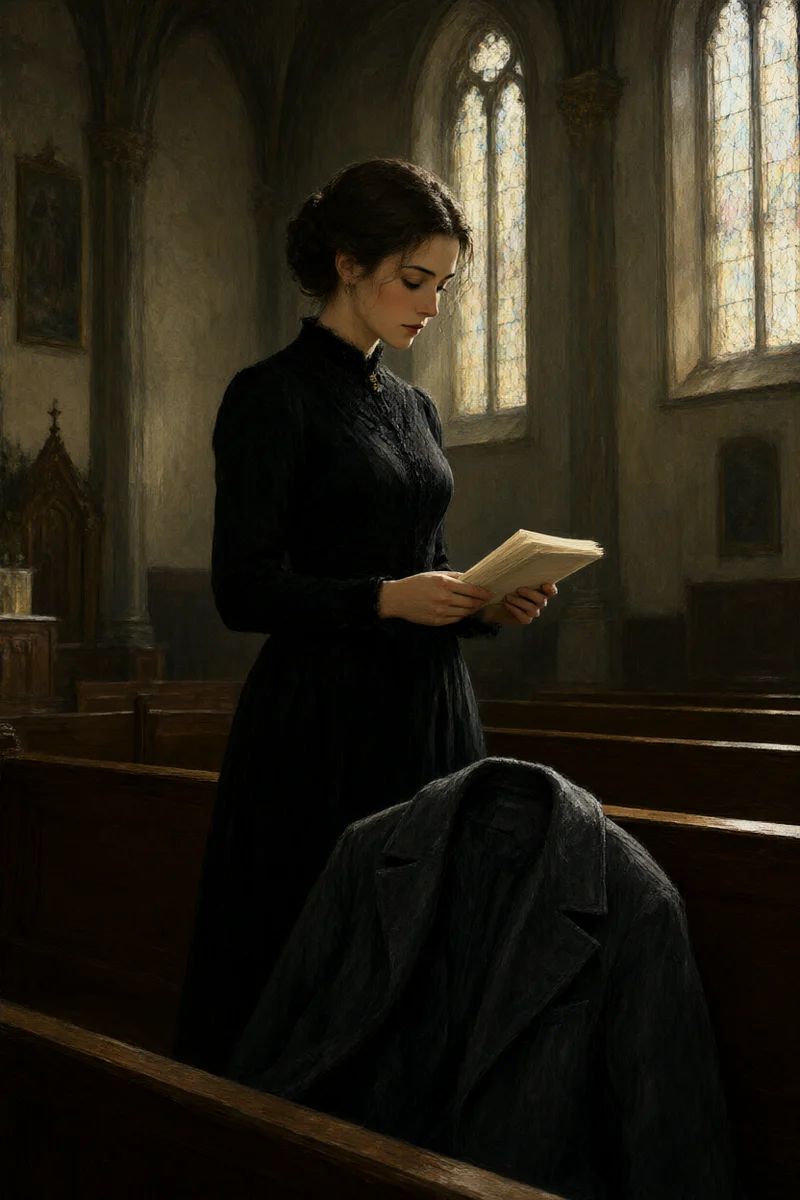
 The Coat on the Pew
Chapter 4
The Sideboard
My mother had sold her house herself, from the hospice bed, in eleven days, to a young couple with a baby and a golden retriever who made the agent nervous. The closing date was in the WHEN notebook, underlined. The buyers took possession on the third of November, which left one thing to move that the estate people couldn't: Mom's walnut sideboard, built by my grandfather in 1952, with a drawer that stuck unless you lifted it as you pulled.
I decided to ask Declan for it. Not as a trap. I had no interest in traps. I wanted to give him one plain, fair, impossible-to-misunderstand chance, so that whatever happened afterwards, I would never lie awake wondering.
I asked him on Sunday night, while he was rinsing the dishes.
“Saturday morning. Nine o'clock. I need you to help me move Mom's sideboard out of the house before the new people come. It's the last thing of hers.” I waited until he turned around. “This is the one thing I'm asking you for. It matters to me more than I can explain.”
“Of course.” He dried his hands. “Nine. I'll borrow Dale's trailer. Noelle, of course.”
That week he was lovely. That is the honest truth and I'm not going to pretend otherwise. He fixed the dripping tap in the upstairs bathroom. He left a sticky note on the coffee machine that said SAT 9AM with a heart. On Thursday he came to bed early and lay with his arm across my waist, and I lay there and let myself imagine unsigning the lease, and the imagining was so warm that I had to get up and drink a glass of water in the dark kitchen.
On Friday night he set two alarms.
On Saturday at eight forty, his phone rang while he was lacing his boots. I heard his voice go up and then go down into the low, competent tone he used for emergencies.
He came into the kitchen with the phone against his chest. “Babe. I'm so sorry. Hal Brody's basement, there's four inches of water, the sump pump's gone and they've got a newborn in the house. I'll be there and back by noon. One o'clock at the absolute latest.”
It was not Rhona. I had been so sure it would be Rhona, and it wasn't, and that was how I knew it had never really been about her.
“Go,” I said. “They've got a baby.”
He kissed me on the forehead. The truck went down the drive. I opened Weather and typed number twenty-five.
Then I called Bev, and Bev called her sons, who arrived at nine twenty with a pickup and a dolly and the bored, enormous patience of men who've been told by their mother not to ask questions.
At ten, a hatchback I knew pulled up behind them. Callum got out of the passenger side with his hood up. Rhona didn't get out; she lifted two fingers off the steering wheel at me and drove away.
“Mom said you might need another pair of hands,” Callum said. He was six foot one and still embarrassed by it. “I'm good at stairs.”
We moved the sideboard. We moved my books, my clothes, my grandmother's quilt, the good knives and my half of the photographs. Callum carried boxes up the iron steps on Wexler Street without being asked and figured out the trick with the drawer on his first try.
By three o'clock there was one box left in the bedroom, the one with my winter shoes. I was taping it shut on the floor of our half-empty closet when I heard a truck turn into the driveway.
Declan was home early. For once in eight years, he was early.
The End









