 Only True Things
Chapter 2
Terms
“That's not how pretending works,” Maren said on Sunday, in the car park again, at two minutes to eleven.
Ivo had brought tulips. He had also, apparently, brought conditions. “I'll hold your hand. I'll sit next to you. If she asks me something I'll answer it. But I don't lie, so you'll have to put up with the answers.”
“Everybody lies.”
“My ex-wife said that too.” He handed her the tulips so she could give them to Hedda herself. “She said I'd never once told her the nice thing. She was right. It was a fair reason to leave.”
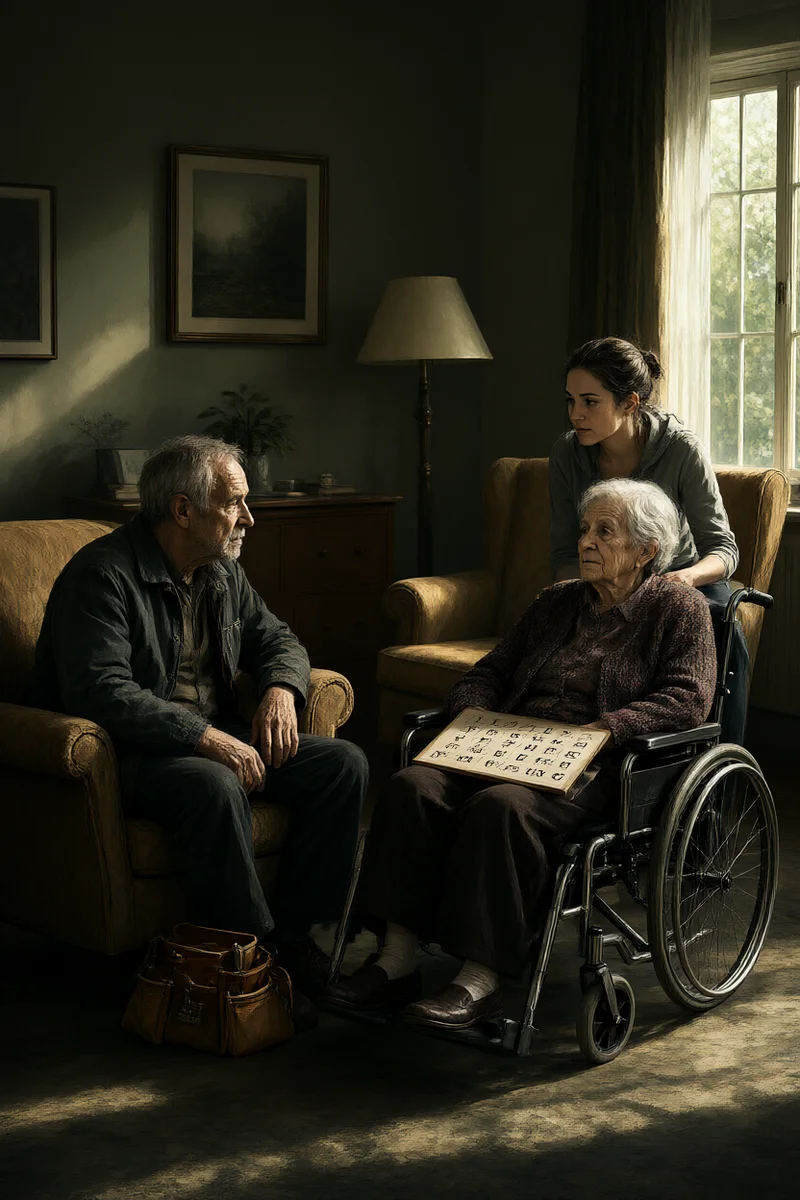
Hedda was in the window of the day room with an alphabet board on her lap, which the speech therapist had given her and which she normally pushed onto the floor. Today she had it gripped in her good hand. When she saw them come in together she pointed, deliberately, at three letters.
W. H. O.
“This is Ivo,” Maren said, and then, because she had never once failed to finish a story: “We met at a friend's party, Gran, in the spring, and I didn't tell you because...”
Ivo, beside her, said, “We met at your boiler.”
Hedda looked from one to the other. Then she pointed at the board again. W. H. E. N.
Maren opened her mouth. Ivo got there first.
“When she asks me properly,” he said. “I'm waiting for that.”
Hedda made the sound that was a laugh. On the walk back to the cars Maren said, through her teeth, “That's a lie,” and Ivo said, “Is it? Ask me properly and see.”
It became a Sunday thing. Eleven o'clock, tulips or chrysanthemums, the window in the day room. Ivo answered every question Hedda put to him and Maren learned to brace for it.
Did he have money? Not much. He fixed boilers and in the evenings he built furniture that sold slowly. Was he kind to Maren? He didn't know yet; ask her. Did he think Maren was beautiful? He thought she was very good at making a room feel calm while she was falling apart, and that he'd never seen anyone so tired.
Hedda's words came back like birds to a feeder, one at a time and then several. “Tea.” “No.” “Him.” By the third Sunday she said “Ivo” perfectly, every time he came in, and nothing yet for Maren but “you.”
Afterwards Ivo and Maren had coffee in the cafe across from Larchmont, because it seemed rude not to. He told her about the furniture. She told him about the hotel, the bride who had wanted doves and the doves that had wanted the buffet. He listened as if she were giving him directions somewhere important.
“You laugh very loudly when you're lying,” he said once.
Nobody had ever told her that. She thought about it all the way home.
On the fourth Sunday the speech therapist, a young woman called Oona Fairley with very cold hands, met them in the corridor with a form.
“Every patient sets their own goal for discharge,” she said. “We ask what they want to be able to do. Most say walk to the shops, or make their own tea.” She turned the form so Maren could read it. Hedda had dictated it a word at a time, and Oona had written it down.
Goal: Attend wedding. Quarry Street. Fourteenth December.
“She says she's booked the room,” Oona said. “She still knows people there.”
The End









