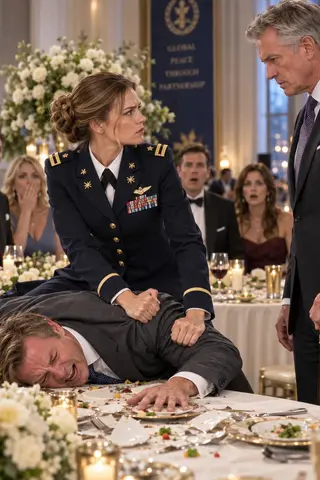
 Billionaire Mocks Navy Pilot as a "Paper Pusher"
Chapter 5
Arthur’s Desperate Gamble
By six o'clock the following morning, the storm had broken over the California Central Valley, leaving Naval Air Station Lemoore bathed in the harsh, flat light of an autumn dawn.
The twin engines of an F/A-18 roared in the distance as I walked across the concrete tarmac toward Building 750, the headquarters for Naval Legal Service Command. The crisp air smelled of JP-5 jet fuel, damp earth, and ozone. It was a scent that had anchored me through twelve years of service, a world governed by duty, checklists, and absolute accountability.
Walking beside me were Julian and a tall, sharp-featured woman in her late forties carrying a leather briefcase. Her name was Evelyn Cross, Harrison Cole’s senior corporate counsel and one of the most feared defense litigators on the West Coast.
"Marcus didn't waste any time," Evelyn said, reviewing a file on her tablet as our boots clicked against the linoleum corridor. "At 1:15 AM, Marcus checked into the emergency room at Mount Zion Hospital. He claimed severe cervical spine trauma, a fractured radius, and multiple lacerations. By 2:30 AM, Arthur’s public relations team had drafted an incident report alleging that an active-duty naval officer went into an unprovoked violent rage at a private dinner party."
"Did they file with the civilian police?" Julian asked, his voice tight.
"They tried," Evelyn said with a cold, amused smirk. "The San Francisco Police Department took the report, but Arthur knew civilian charges would take weeks to process. He wanted immediate leverage. Marcus sits on the regional advisory board for the Navy League. He used an old connection in the Assistant Secretary of the Navy’s office to trigger an immediate, high-priority military inquiry for conduct unbecoming an officer under Article 133."
"Arthur wants my wings," I said calmly.
"Arthur wants your surrender," Evelyn corrected. "He sent an email to Julian’s personal address at 4:00 AM. In exchange for Marcus withdrawing the complaint, Arthur demands that Julian sign over the intellectual property for the pediatric surgical patents, issue a joint statement endorsing Sterling Capital, and facilitate a public reconciliation dinner."
"He’s backed into a corner," Julian said, his jaw clenching. "The bank called him at midnight. When Harrison liquidated his shares in Marcus’s tech firm, rumors swept through the venture market like wildfire. Sterling Capital’s credit line was frozen this morning. Arthur is drowning, and he thinks he can use my wife's career as a life raft."
We reached the frosted glass doors of the Judge Advocate General’s office.
Inside the hearing room, sitting behind a long walnut conference table, were two officers: Captain Robert Hastings, a weathered Navy lawyer with twenty-five years of service, and Commander Sarah Lin, the executive officer of my air wing.
Across from them sat Arthur Sterling and Marcus.
Marcus looked like a mummy. He wore an elaborate cervical collar around his neck, and his right arm was encased in a pristine white fiberglass cast. A large white bandage was plastered across his cheekbone. He slumped in his chair with an expression of rehearsed, theatrical agony, looking like a man who had barely survived an explosion.
Arthur sat beside him, wearing a bespoke double-breasted suit, his hands clasped over a leather dossier. When Julian and I walked through the door, Arthur didn't look at his son. His eyes bored into me with pure, venomous satisfaction.
"Lieutenant Commander Vance," Captain Hastings said, gesturing toward the empty chairs across from Arthur. "Take your seat."
"Good morning, Captain," I said, executing a crisp salute before sitting down.
"Captain Hastings," Arthur spoke up immediately, his voice booming with artificial authority. "I want to thank you for convening this emergency session. As a taxpayer and a longtime supporter of our armed forces, it breaks my heart to see the uniform dishonored in such a barbaric fashion. Marcus is a pillar of the tech community, a philanthropist, and a man of peace. What Lieutenant Commander Vance did to him in my home was nothing short of an unprovoked criminal assault."
Marcus let out a weak, pathetic groan from behind his neck brace. "She... she came at me without warning, Captain. I merely asked her a polite question about her deployment, and she snapped. Look at what she did to my arm! The doctors say I might never regain full mobility!"
Commander Lin leaned forward, her eyes narrowing as she studied Marcus’s cast. "Mr. Vance, our medical liaisons reviewed the preliminary triage report from Mount Zion. There was no bone fracture indicated on the initial X-rays."
"Soft tissue damage!" Arthur interrupted smoothly. "Severe ligamentous tearing! The orthopedic surgeon recommended full immobilization! But the physical damage is secondary to the psychological trauma. A commissioned officer trained by the United States government used lethal combat techniques against an unarmed civilian. If this reaches the press—and believe me, my media contacts are waiting for my signal—the Navy’s reputation will be dragged through the mud."
Arthur leaned over the table, his eyes gleaming with triumphant malice.
"We are willing to handle this matter quietly," Arthur continued, lowering his voice into a conspiratorial purr. "If Lieutenant Commander Vance submits her immediate resignation from the service, accepts an administrative discharge, and steps away from public life, Marcus will agree not to press formal charges with the Department of Justice."
Captain Hastings looked at Arthur, then at me.
"Commander Vance," Hastings said. "Do you have anything to say before we proceed?"
I didn't blink. "I do, Captain. But before I speak, my counsel has submitted an evidentiary filing that requires the panel's review."
Arthur laughed out loud—a sharp, dismissive bark. "Evidentiary filing? What evidence? It was a private dinner! There were no cameras in my dining room, Elena! It’s your word against ten distinguished corporate executives!"
"There were no cameras, Arthur," a commanding voice boomed from the doorway. "But there was a microphone."
The double doors swung open with a resounding thud.
Harrison Cole stepped into the room.
The End









