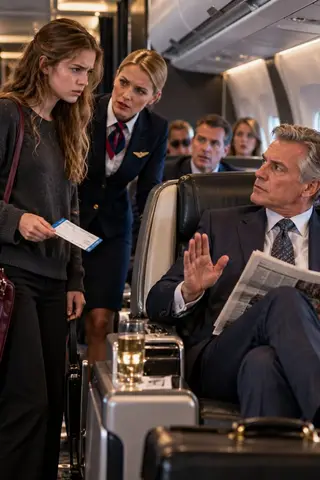
 Arrogant CEO Refused To Give Up A 14-Year-Old’s First Class Seat
Chapter 31
The Twelve Ghosts
The silence inside Marcus Sterling’s Manhattan penthouse was so absolute that the hum of the air-handling unit sounded like an approaching squall. Outside, across the neon-drenched canyon of Times Square, the hijacked commercial billboard pulsed like an open artery, its scarlet map tracking twelve distinct trajectory vectors across three oceans.
"Twelve planes," Frank murmured, his knuckles white around the grip of his tablet. His voice had the flat, hollow timbre of an aviator who had run out of airspeed, altitude, and ideas all at once. "Over three thousand passengers. Pacific Sector Six, Indian Ocean Corridor Four, and the Mediterranean eastern transit. All twelve flight decks have been locked out. The primary fly-by-wire buses aren't responding to local yoke inputs."
Zara did not scream. She did not cry. The fourteen-year-old girl simply sank back into her carbon-fiber task chair, her dark eyes darting across the diagnostic cascade spilling down her workstation’s three monitors. Her fingers were already moving over the mechanical keys, a rapid, metronomic clatter that cut through the terror in the room.
"It’s not the same code," Zara said, her voice dropping into the eerie, cold calm Marcus recognized as her deep-focus state. "The Hangar Seven exploit was an injected Trojan in the terrain avoidance system. This... this is root-level firmware. It’s sitting in the secondary avionics backplane. Dad, whoever built this didn't breach our networks tonight. They built these chips into the airframes during assembly three years ago."
Marcus stepped up behind her, his large hands resting firmly on the back of her chair. The paternal warmth in his touch was deliberate—an anchor against the void. But inside his chest, his heart felt like cold iron.
"Supply chain infiltration," Marcus said, looking at Frank. "Who supplied the secondary bus multiplexers for the 2023 fleet refit?"
"AeroDynamic Components Consortium," Frank answered instantly, frantically swiping through historical maintenance manifests on his handheld. "A tier-one supplier based out of Zurich, with fabrication foundries in Singapore. Marcus... Graves didn't own ADCC. He was just a minority board member. Who the hell was pulling his strings?"
"Whoever called that satellite line," Marcus said grimly. "Look at the telemetry, Zara. Where are they vectoring them?"
Zara split the center screen into twelve tactical windows. Each window displayed an altitude-versus-speed curve for the hijacked jets. "They aren't diving," she observed, her brow furrowing in confusion. "If they wanted mass casualties, they would have plunged them through Mach one into the water like they tried with Flight 101. They’re... climbing. All twelve are ascending to maximum certified ceiling—forty-three thousand feet—and trimming for maximum range cruise. They’re converging on designated maritime dead zones where there's zero civilian radar and minimal military satellite reconnaissance."
"Holding patterns," Marcus deduced, his mind racing through maritime coordinates. "They’re gathering them into three four-ship formations. Why put commercial airliners into tactical holding over empty ocean?"
Before Zara could analyze the telemetry further, the private red terminal on the credenza chirped once. It wasn't an incoming audio call this time. It was a single, encrypted packet delivered via a quantum-resistant direct burst from an unknown maritime relay.
Zara captured the packet mid-flight and decrypted the header using the private Sterling cipher. A single video feed initialized on the center display.
The camera was positioned high in the corner of a dimly lit, immaculate command bunker. At the center of the frame sat a man in a bespoke navy suit, sipping tea from a delicate porcelain cup. Behind him, dozens of uniformed operators monitored rows of amber-glowing military tactical consoles.
The man set his teacup down and looked directly into the lens.
"Good evening, Marcus," the man said. His voice was no longer masked by a synthesizer. It was cultured, aristocratic, and chilled with absolute certainty. "I believe you know my name. Though you haven't spoken it since our days at Oxford thirty years ago."
Marcus’s jaw hardened, his eyes narrowing to razor slits. "Julian Vance."
The End









