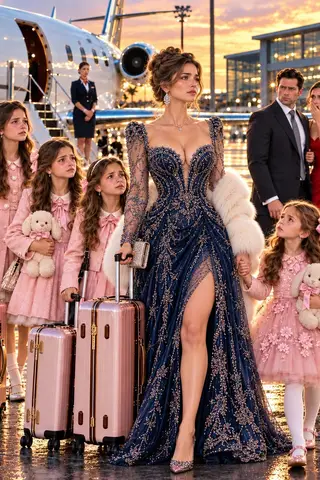
 After divorcing with nothing to her name, the wife flew away with her four daughters
Chapter 2
The Roots of the Empire
To understand the magnitude of the betrayal, one has to look back at what Pacific Oak Crafting truly was before Raymond and his mother claimed it as their exclusive birthright. When I first met Raymond in my late twenties, he was charming, ambitious, but entirely broke. His father, Walter, owned a dusty, dilapidated workshop near Chula Vista that specialized in custom wooden furniture, but it was suffocating under a mountain of debt, unpaid supplier invoices, and outdated machinery that constantly broke down.
At the time, I was working as a senior logistics coordinator in furniture distribution. I had spent years meticulously building my personal savings from successful real estate investments and smart career moves. When Walter’s business faced imminent foreclosure, my parents stepped in, selling a cherished parcel of agricultural land they had owned for decades to help fund my vision. Together, we poured nearly six million dollars into the dying enterprise.
I didn't just invest money; I poured my soul into it. I spent eighteen-hour days sleeping on a cot in the back office. I traveled across the state to secure timber suppliers, renegotiated supplier contracts, modernized the production line with computer-numerical-control machinery, and designed an administrative structure that transformed a local workshop into a regional manufacturing powerhouse. Within a decade, we owned two massive production plants, employed over one hundred and eighty skilled craftsmen, and held exclusive supply contracts with major commercial developers throughout Southern California.
Yet, despite my undeniable sweat equity and financial foundation, the ownership structure had always been a subtle battleground. Legally, I held forty-three percent of the company shares, a percentage hard-fought during corporate restructuring. Walter held twenty-four percent as the original founder, and Raymond held thirty-3 percent. Gavin, Raymond’s younger brother, was deliberately excluded from the ownership structure because of his reckless lifestyle, gambling debts, and repeated failures in shady business ventures. Gavin despised me because I was the barrier blocking him from looting the company coffers.
Florence, however, viewed the corporate hierarchy through the lens of a medieval dynasty. To her, a business empire could only be passed down through a male heir. Every board meeting, every family dinner, and every holiday gathering was laced with her passive-aggressive remarks about my "failure" to secure the Miller bloodline. When Gaby was born, Florence smiled tightly and called her a "sweet start." With Paige, she asked when the real work would begin. By the time Maya arrived, the hospital visits stopped entirely. And when Zoey was born, Florence stood at the foot of my bed, looked at my newborn baby, and asked the question that still echoed in my ears: “Who is going to inherit the factory one day if all you have are girls?”
Raymond, who had initially been grateful for my financial rescue, gradually adopted his mother’s toxic worldview. As the company grew more profitable, his ego swelled. He began staying out late, attending high-society networking events without me, and eventually, carrying on a brazen affair with Brenda, a social climber who knew exactly how to stroke his fragile ego. When Brenda conveniently fell pregnant and produced a baby boy, Raymond and Florence acted as though they had discovered the Holy Grail. They commissioned private DNA tests—tests orchestrated under Florence’s strict supervision—to prove beyond a doubt that the child belonged to Raymond.
I had fought to keep the marriage together for years, enduring the slights, the cold shoulders, and the blatant disrespect, believing that my daughters deserved a complete family. But when Raymond demanded a divorce to marry Brenda and install her as the new queen of the Miller household, while offering me a fraction of my true corporate worth in a coerced settlement, I knew I had reached the end of the road. I chose my daughters' emotional well-being over a toxic corporate throne.
As our plane climbed above the clouds, leaving the coastline of Southern California behind, I looked out the window at the endless expanse of blue sky. I had lost a husband, a home, and a company I built with my own hands. But as I felt little Zoey’s head resting softly on my shoulder, I knew I hadn't lost my strength. And far away in San Diego, Teresa was lacing up her shoes, preparing to detonate a truth that would shake the Miller estate to its very foundations.
The End









