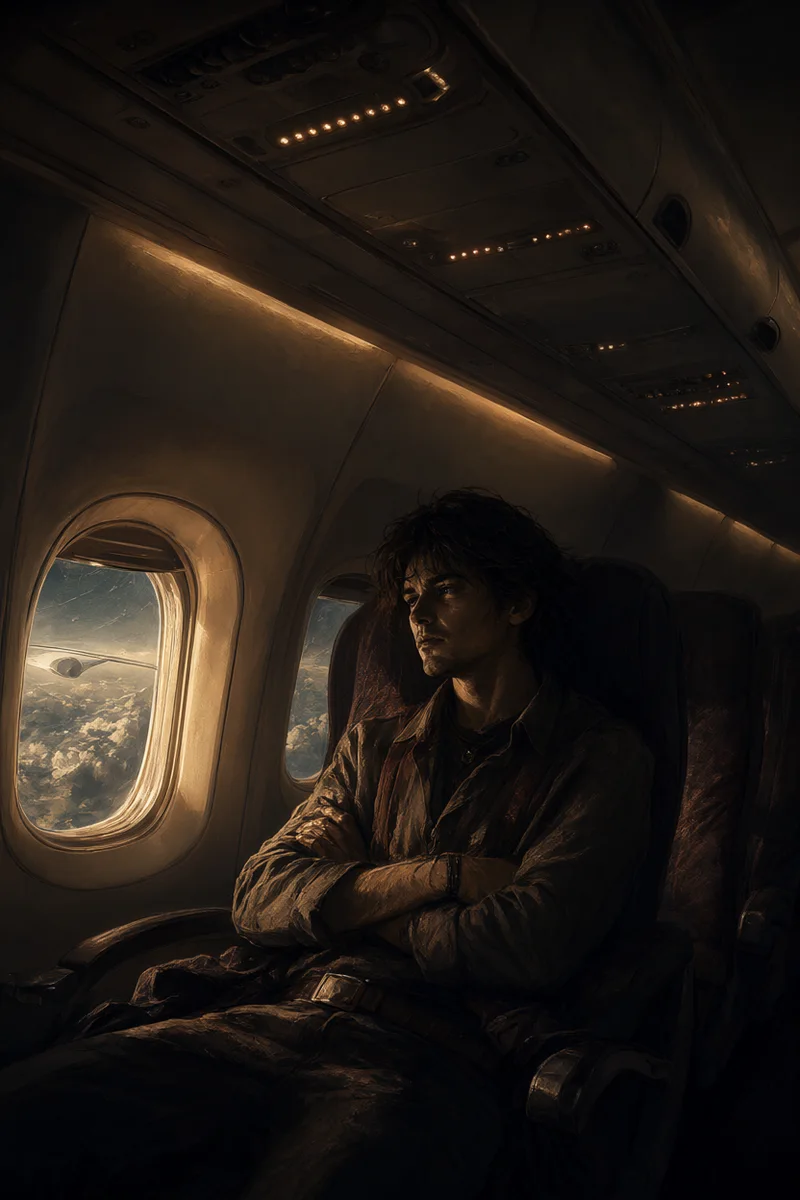
 A Quiet Passenger Kept Sleeping While The Captain Begged For Help
Chapter 3
The Ghost of the Skies
The moment Flight Control Computers one and three powered down, the violent, shuddering vibrations that had racked the giant airframe ceased with miraculous abruptness. The terrifying aerodynamic feedback loop was broken. However, the momentary relief vanished as Marcus realized the terrifying reality of their physical situation: three hundred tons of aluminum, jet fuel, and human lives were now resting entirely upon the raw strength of his wrists, the sensitivity of his fingertips, and the precise manipulation of his throttle fingers.
The aircraft's nose dipped sharply downward. The altimeter reeled backward with sickening speed: 33,000 feet, 32,500 feet, 32,000 feet. Mach .82 and accelerating.
"Airspeed is bleeding away! We're entering a secondary stall warning!" Reynolds shouted, his voice tight with rising panic as the stall klaxon began its frantic intermittent braying.
"I've got the aircraft," Marcus replied, his voice dropping an octave into an absolute, meditative calm.
In high-stress combat maneuvers, panic manifests as brute force—yanking back hard on the stick when an aircraft begins to sink. But Marcus knew that brute force against a crippled heavy-body jet at high altitude was fatal. When airflow separates from the wing root, pulling back only deepens the stall. Instead, he smoothly pushed the control column slightly forward to re-establish clean laminar airflow over the main wing spar, coaxing the sky back under his control.
With his left hand, he advanced throttles two and three forward by a precise fraction of an inch, leveraging asymmetrical engine thrust to manipulate the yaw axis without overstressing the ruptured hydraulic lines in the tail assembly. At the same time, his right thumb rhythmically flicked the manual pitch trim switch on the yoke, feeling through the physical feedback as the mechanical jackscrew bit into the rushing slipstream.
Slowly, almost magically, the heavy nose arrested its plunge. The screaming gale of wind rushing against the cockpit windshield smoothed out into a steady, deep, rhythmic hiss.
Altitude: 28,000 feet. Level flight. Wings neutral. Heading stable.
Captain Reynolds slumped back against his seat cushion, breathing in ragged, gasping intervals as if he had just sprinted a marathon across open terrain. He turned his head slowly, staring in undisguised awe at the calm, methodical way Marcus's hands rested on the controls.
"Where on earth," Reynolds whispered, his voice trembling with lingering adrenaline, "did you learn how to trim a crippled widebody using asymmetrical engine thrust and raw mechanical linkage?"
Marcus kept his eyes locked on the amber horizon line of the backup artificial horizon. "When you don't have an ejection seat beneath you, and your family is waiting at the end of the runway, you learn very quickly how to listen to what the machine is trying to tell you."
Without missing a beat, Marcus transitioned from crisis management to tactical execution. "Captain, we need to coordinate our next moves. Call Shannon Oceanic Control immediately. Declare a formal Mayday. Inform them we've suffered a dual hydraulic failure and a complete FCC crash. Request emergency vectors for a straight-in visual and instrument approach to Shannon Airport on the west coast of Ireland. Advise them we will be landing with minimum flap settings and zero reverse thrust available on engine number two until the nose gear touches the pavement."
Reynolds nodded vigorously, grabbing the VHF radio mic with a renewed sense of professional purpose. "Shannon Oceanic, Shannon Oceanic, this is Boeing 777-300ER, call sign Speedbird 617, declaring Mayday, Mayday, Mayday..."
As the radio crackled to life with crisp, urgent directives from Irish air traffic controllers scrambling to clear the transatlantic corridor below them, Marcus adjusted his headset. He looked out through the rain-streaked windscreen into the dark, churning expanse of the North Atlantic night. For eight years, he had convinced himself that Major Marcus Cole was dead and buried beneath software documentation and bedtime stories in Chicago. But sitting here in the right seat, feeling the subtle pulse of the engines through his palms, he realized that some parts of your soul never leave the cockpit. They simply wait in the dark for the exact moment the world needs them to wake up.
The End









