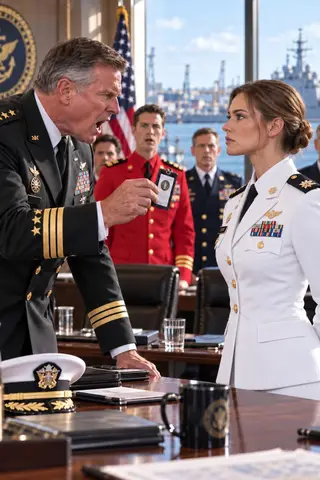
 A 4-Star SEAL Legend Laughed At My Rank
Chapter 2
The Sinking of Ghost-Six
Six months before I walked into Harlan’s sanctuary, my world had collapsed in the rain-swept grass of Arlington National Cemetery.
The ceremonial rifles had fired their three volleys. The sharp, acrid scent of spent gunpowder hung heavy in the damp Virginia air, mingling with the scent of wet carnations and fresh-dug earth. I stood in my service dress blues, my shoes sinking slightly into the turf, holding my eight-year-old niece Maya by the hand while my ten-year-old nephew Caleb clung to his mother’s black coat.
My sister Sarah hadn't cried during the service. She had been frozen, her eyes wide, staring at the polished mahogany box draped in the Stars and Stripes.
The casket was empty.
Captain Jonah Pierce—decorated naval aviator, devoted father, and the man who had taught me how to rebuild a boat engine when I was sixteen—had not been recovered from the Pacific. His MH-60S Seahawk, callsign Ghost-Six, had plunged into seven thousand feet of water off the coast of Guam during what the official Navy report termed a “routine night-navigation training evolution.”
The official letter delivered to Sarah had been three pages of antiseptic military jargon: Sudden mechanical catastrophic event. Severe downdraft. Inability to maintain altitude. Non-survivable impact.
It was signed by Rear Admiral Knox Harlan.
Two days after the funeral, I sat in Sarah’s quiet kitchen in Annapolis. The kids were asleep upstairs, exhausted from days of grief they didn't know how to process. Sarah sat across from me at the kitchen table, a single yellow sheet of paper gripped between her shaking fingers.
“Jonah called me,” Sarah whispered, her voice barely louder than the hum of the refrigerator. “Thirty minutes before he boarded that helicopter.”
I looked up from my untouched cup of tea. “He wasn't supposed to have comms access during pre-flight on a black-budget exercise.”
“He called from a burner phone,” she said, tears finally breaking through her stoic barrier, cutting clean lines through her exhaustion. “He was scared, Evelyn. In twelve years of marriage, through two tours in the Gulf and one in the Horn of Africa, Jonah was never afraid. He told me... he told me Harlan was forcing them to lift off in a Category Three perimeter. Not for training. For an unscheduled extraction.”
I felt a cold prickle at the base of my skull. “What kind of extraction?”
“He wouldn't say. He said the cargo didn't have manifest numbers. He said if he refused the order, Harlan threatened him with a general court-martial for mutiny. He said... 'Sarah, if the water takes us tonight, don't let them tell you it was an accident. Look for the black ledger.'”
Sarah shoved the paper across the table. It was a sequence of ten alphanumeric characters Jonah had rattled off in haste, scribbled in her hurried, desperate handwriting: V-77-N-D-9-9-H-A-R.
I was a lieutenant commander in the Naval Inspector General’s office at the time. I spent my days reviewing procurement fraud, supply chain kickbacks, and administrative misconduct. But I was also Navy. I knew how the machine worked. I knew that helicopters didn't fly in typhoons unless someone very powerful needed something moved very quickly.
The next morning, I bypassed my immediate supervisor and submitted a formal request for Ghost-Six’s raw telemetry data.
By noon, my request had been flagged, denied, and stamped with a red seal: RESTRICTED UNDER SPECIAL ACCESS PROGRAM – COMMANDING OFFICER NAVAL SPECIAL WARFARE COMMAND.
Two days later, my office computer was wiped clean in a surprise "system maintenance overhaul."
That was the moment I stopped being an auditor. That was the moment I became a hunter.
I spent four months working in the shadows of the Pentagon. I traded favors with old academy classmates in satellite communications. I spent long nights in the dim archives of the Navy Yard, cross-referencing ship movements, contractor invoices, and civilian maritime cargo manifests off the coast of Micronesia.
What I found made my blood run cold.
Jonah’s helicopter hadn't been on a training run. It had been dispatched to a civilian salvage vessel chartered by Aegis Trident Dynamics—a private defense contractor heavily bankrolled by retired flag officers. The salvage ship was working over the wreckage of an experimental Chinese submersible that had sunk in neutral waters weeks prior.
Harlan wasn't running a military exercise. He was running an illicit, off-the-books salvage operation to retrieve advanced foreign guidance chips before the official fleet salvage units could secure the site. The profits from that technology—funneled through shell corporations—were worth hundreds of millions.
Jonah had realized what they were carrying. He had protested. And Harlan had ordered him into the sky in the middle of a gathering tempest to ensure the cargo made it to a private airstrip on Tinian before dawn.
Ghost-Six never made it.
I took the file straight to the Chief of Naval Operations. Admiral Vance was an old-school surface warfare officer who despised backroom corruption. He looked at my evidence for three hours without speaking.
When he finally looked up, his eyes were cold granite.
“If I send the shore patrol to arrest Harlan right now, his allies in the Senate will tie this in knots before nightfall,” Vance had told me, his voice low and heavy. “They will shred the files. They will claim administrative error. You need the raw hard drives from Coronado’s central vault. You need the telemetry before his techs wipe it.”
He signed the crimson folder and pushed it across his desk to me.
“Go to California, Commander,” Vance said. “Break his door down. And bring me his head.”
The End









