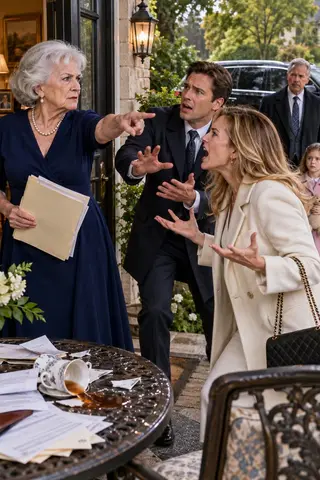
 77-Year-Old Mom Spends $93K on Son's Townhouse, Gets Text Saying 'You're Not Invited'
Chapter 1
The Hollow Invitation
The rain tapped rhythmically against the kitchen windowpane, each drop a tiny metronome measuring out the quiet devastation of a life built on sacrifice. At seventy-seven years old, Martha Kelley stood before her full-length mirror, smoothing the navy blue silk of a dress she had purchased specifically for her son’s townhouse warming dinner. It was 6:18 p.m. Her hands, adorned with the faint blue tracery of veins and a wedding ring that now slid loosely over her knuckle, carefully pressed the fabric flat.
On the kitchen counter, the kettle sat entirely dry, having clicked off moments ago without a drop of water poured. The room was heavy with the familiar, melancholic scent of lemon polish, aging oak, and the ghost of routine. Across the room, upon the mantelpiece, rested the framed photograph of Thomas—her late husband of fifty years—and beside it, the gleaming silver earrings he had given her for their golden anniversary. Next to those sentimental relics lay a glossy, thick-paper brochure that Benjamin, her only son, had mailed her back in March. The pages were filled with digitally enhanced images of pristine white trim, impeccably arranged designer furniture, and smiling, youthful couples posing against a backdrop of suburban luxury.
"For you too, Mom," Benjamin had promised over the phone, his voice carrying that smooth, reassuring cadence that had always managed to dissolve her doubts.
She had believed him. Because mothers are fundamentally wired to recognize love, even when what they are actually hearing is merely convenience disguised as filial devotion. A sharp, metallic taste coated her tongue, rising from the pit of her stomach. The digital clock on the microwave glowed 6:20 p.m. Her phone buzzed against the polished wood table.
It was Benjamin.
"Mom, the plans have changed," the first message read.
Before she could even shift her weight from the kitchen chair, a second notification lit up the screen.
"You weren’t invited. My wife doesn’t want you there."
Martha stared at the words. She read them once, twice, five times, stripping away any possibility of a misplaced keystroke or a delayed autocorrect error. The message stood stark, cold, and final. Genevieve, her daughter-in-law, had never needed to raise her voice to inflict maximum damage. Her cruelty was far more sophisticated, wrapped securely in polished etiquette, immaculate table manners, and soft-spoken declarations that she could later deny with a practiced blink of innocence.
"Your mother makes people uncomfortable," Genevieve had once remarked with a breezy, societal smile while sipping a fourteen-dollar artisanal coffee that Martha’s credit card had ultimately funded. "She means well, but still."
At the time, Martha had simply laughed. A small, dry, practiced sound—the universal acoustic defense mechanism of women who have spent decades trying desperately not to become a burden to their own children. Now, standing alone in the quiet kitchen, that laugh felt like glass grinding in her chest.
She walked slowly over to the old mahogany desk that had once belonged to her mother. Pulling the stubborn bottom drawer open, she retrieved a thick, worn manila folder labeled simply with a single word written in her own handwriting: BENJAMIN. Inside was a meticulously organized archive of silent rescues spanning over a decade and a half. College tuition installments. Private health insurance premiums. Unexpected mortgage assistance injections. Country club annual dues. Emergency wire transfers that had somehow mutated into permanent monthly line items. There was a receipt for a two-thousand-eight-hundred-dollar preschool payment for her granddaughter, and another for a six-thousand-four-hundred-dollar emergency home repair that Genevieve had sworn on her own mother’s grave would be a strictly one-time loan.
Old paper possessed a distinct, melancholic olfactory signature: a dense mixture of accumulated dust, faded typewriter ink, and a profound, generational grief that had been folded neatly and tucked away out of sight.
At 6:47 p.m., her granddaughter’s face popped up on the screen.
"Grandma, are you coming?"
Martha stared at those four innocent words until her eyes burned with hot, unshed tears. Children are entirely innocent bystanders in the invisible wars fought by adults, rarely understanding the massive masonry walls being erected between them and the people who loved them most.
With fingers that barely trembled, Martha typed her response: "Not tonight, sweetheart. I love you."
She laid the phone down, walked past the framed photograph of Thomas, and lifted the heavy black landline receiver. She did not call Wesley, her pragmatic eldest nephew. She did not call Serena, her sympathetic sister in Ohio. And she certainly was not going to debase herself by begging for a crumb of hospitality at a dinner table she had personally financed brick by brick.
When the First National Bank emergency automated prompt answered, her voice was startlingly steady. The customer service representative requested verification. Martha provided her exact birthdate, Thomas’s middle name, the last four digits of her social security number, and the private verbal password she had established back when the account was opened in 1998.
Then came the inevitable question from the other end of the line: "Which authorizations would you like us to cancel, Mrs. Kelley?"
"All of them," Martha said, her voice dropping an octave into absolute stillness. "Every single recurring payment connected to Benjamin Kelley."
A heavy, electronic silence hummed over the copper wires, followed by the rapid-fire clatter of computer keys. It sounded precisely like a mother waking up from a fifteen-year hypnotic sleep, remembering that before she was a safety net, she was an independent human being. At 7:03 p.m., Martha picked up her cell phone, unlocked the screen, and composed her final message to her son.
"Then you and your wife can start paying your own way."
She hit send, powered the device completely off, unfastened the heavy pearl earrings from her lobes, and placed them gently beside Thomas’s picture. The war was over. The accounting had begun.
The End









