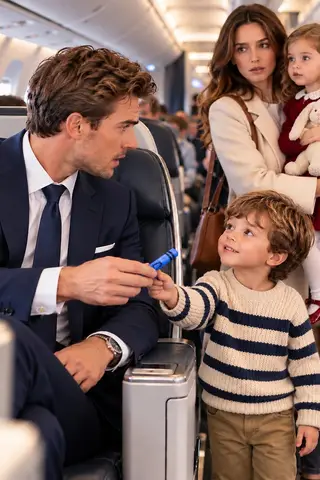
 $740M CEO Flies to Close the Deal of a Lifetime
Chapter 1
The Blue Crayon That Stopped a Billion-Dollar Flight
The altitude was thirty-eight thousand feet, cruising smoothly somewhere over the icy expanse of the Midwest, but inside my head, a Category 5 hurricane was raging.
I am Adrian Prescott. At forty-one, I was the undisputed, ruthless, and highly compensated CEO of Meridian Technologies in Seattle. For twelve grueling months, I had sacrificed my sleep, my social life, and my soul to engineer a hostile-turned-friendly acquisition of Clearhaven Medical. The price tag was $740 million. It was the crowning achievement of my career, the validation of every late night, every missed holiday, and every broken relationship I had left in my wake.
We were landing in Chicago on Christmas Eve. The board of directors was waiting at the historic Drake Hotel. My legal team had champagne chilling, and the press was outside ready to flash cameras at the sealing of a legacy.
My phone buzzed against the leather tray table. It was Tessa Caldwell, my Chief Operating Officer. Her face, when I flipped the phone on, was tight with corporate panic.
"Adrian, legal needs your final sign-off on the indemnity clause," Tessa said, her voice filtered through static and high-speed satellite wifi. "Clearhaven's counsel is threatening to walk if we don't lock down the intellectual property rights before midnight. We can’t afford another delay. The board is getting cold feet."
"Relax, Tessa," I said, leaning my head back against the first-class plush headrest. "The ink will be dry before Santa slides down the chimney. I’ll sign off the second my wheels touch down at O'Hare."
"You better, Adrian," she warned, her voice dropping an octave. "Too much is riding on this. If this falls through, the stock price will crater, and the board will be looking for a scapegoat. Make sure your head is in the game."
"My head is right where it needs to be," I lied smoothly.
I hung up, tossing the phone aside. My life had always been a series of transactions, leverage points, and bottom lines. Love, family, and domestic comfort were variables I had learned to prune away early in life. My father had been a struggling accountant who died broke and stressed, vowing that care and kindness paid no bills. I took that lesson to heart. I built Meridian Technologies out of a dingy garage in Redmond, scaled it to a behemoth, and hardened my heart into a diamond-tipped drill bit.
I opened my laptop, the screen illuminating the dim, ambient cabin lighting. Document after document scrolled past—indemnity clauses, non-compete agreements, stock options, escrow accounts. $740 million. It was a staggering number, enough to buy an island, a fleet of private jets, and immortality in the tech chronicles.
Then, out of the corner of my eye, a flash of cobalt blue darted across the navy carpet of the first-class aisle.
It rolled past my leather designer shoes, clinked lightly against the aluminum leg of my seat frame, and came to a quiet stop.
I blinked, momentarily pulled out of my financial spreadsheet trance. I looked down.
A blue crayon. A cheap, waxy, elementary school crayon.
Before I could annoyance-sigh and kick it back out of my personal space, a small, shuffling pair of sneakers halted right beside my seat.
"Sorry, mister," a small, high-pitched voice piped up. "My crayon got away from me. It's a runaway train."
I turned my head, my lips parting to offer a polite, dismissive corporate smile—the kind I used on junior developers who asked stupid questions. But the smile dissolved the instant my gaze locked onto the child.
He was maybe two years old, wearing a cozy forest-green wool sweater. His hair was a chaotic, untamed mop of dark brown curls. But it wasn't the hair, and it wasn't the clothes.
It was his eyes.
Clear, luminous, unmistakably gray-green. The exact, rare genetic anomaly I had inherited from my maternal grandfather—a color so distinct that people stopped me on the street to ask if I wore colored contacts.
I froze. My breath hitched in my throat, trapping a sharp gasp behind my teeth.
"Well," I managed to say, my voice sounding like gravel grinding together. "We can’t have runaway trains escaping all over the airplane. Security might have to arrest it."
The boy giggled—a bright, chiming sound that vibrated straight through my sternum. He flashed a wide, open-mouthed grin.
And right beside the left corner of his mouth, a tiny, perfect, crescent-moon dimple punched into his cheek.
My dimple. The exact mark I stared at every single morning when I shaved.
My laptop screen blurred. The $740 million acquisition vanished from my mind as if it had never existed. A cold sweat broke out across the back of my neck, fighting the cabin's artificial warmth.
"Bennett, honey, come back to Mommy. Don't bother the gentleman."
The voice drifted down the aisle from row three, soft, melodious, and etched permanently into the deepest archives of my memory.
The blood rushed out of my brain so fast I thought I was going to faint. My ears began to ring with a high-pitched, deafening whine.
I knew that voice. I would know it if I were deaf, if I were buried six feet under, if I were spinning through the vacuum of outer space.
Emily Carter.
The woman I had loved with a fierce, burning obsession three years ago—before ambition consumed me, before I packed my bags and told her that my startup's Series B funding round was more important than attending her sister's wedding, before I walked out of our shared apartment in Seattle and never looked back.
I stood up so fast my knees knocked against the tray table, sending my laptop sliding with a sickening clatter.
I turned around in the narrow aisle.
And there she was.
Emily stood by the galley bulkhead. She was wearing a simple camel-colored coat, her long chestnut hair pulled back into a messy bun that looked effortlessly elegant. And riding on her right hip was a little girl with the exact same curls, the same stubborn tilt of her chin, and those unmistakable gray-green eyes.
Emily froze.
The color drained from her face so completely she looked like a marble statue carved out of grief and shock. Her fingers tightened around a diaper bag strap until her knuckles turned translucent white.
For three terrifying, endless seconds, the Boeing 777 cabin felt like it had dropped into a soundproof vacuum. The hum of the jet engines faded away. There was only Emily, the twins, and the crushing weight of a past I thought I had successfully buried.
"Adrian?" she whispered, her voice cracking like dry winter twigs.
I looked from the boy—Bennett—to the little girl in her arms, and finally back to Emily’s wide, tear-rimmed eyes.
"What is this?" I demanded, my voice raw, shaking with a terror I had never experienced in any boardroom.
Emily’s lower lip quivered. She swallowed hard, tears finally spilling over her lashes and cutting tracks down her pale cheeks.
"Adrian..." she choked out.
"How old are they?" I demanded, taking a half-step toward her, ignoring the stares of the passengers around us.
Emily closed her eyes for a agonizing second. "Two. They were born on December twentieth."
My stomach plummeted down into the cargo hold. Two years old. That meant they were conceived right around the time our relationship was bleeding out, right before I walked out the door and blocked her number, telling myself that love was a distraction for the weak.
"Emily," I breathed, my chest tightening until my ribs felt like iron bands. "Why didn't you tell me?"
Her eyes snapped open, flashing with a sudden, searing fury that burned away her tears.
"I did!" she shouted, ignoring the flight attendant who popped her head out of the galley. "I tried everything, Adrian! I wrote to you, I called your office every single day for months, I sent registered mail, I left messages with your executive assistants!"
I shook my head violently, panic clawing at my throat. "No. No, you didn't. I never got anything. My assistants screen my calls, but mail comes directly to my executive suite. I would have known!"
Emily’s jaw set into a hard, unyielding line. She shifted the little girl to her left hip, reached her trembling hand deep into the cavernous pocket of her diaper bag, and pulled out a worn, yellowed manila envelope.
She shoved it toward my chest.
"I kept this," she said, her voice dropping to a fierce, dangerous whisper. "Look at it, Adrian. Look at the address. Look at the stamp."
I reached out with shaking fingers and took the envelope. My eyes scanned the front.
Adrian Prescott, Chief Executive Officer
Meridian Technologies, Executive Suite 4200
1000 First Avenue, Seattle, WA
And right across the bottom left corner, stamped in bright, official red ink, was a formal delivery confirmation signature.
Received.
Signed by: Tessa Caldwell, COO.
My blood ran instantly cold. The $740 million deal, the board of directors waiting in Chicago, the prestige, the power—it all dissolved into ash.
Someone inside my own company had intercepted the mail. Someone had looked at Emily’s desperate pleas, looked at the proof of my flesh and blood, and deliberately buried it.
The End









